

In the last 2 articles, I’ve argued that a card game, involving 3 special decks of cards (purple, green and pink) is an excellent analogy for the economy, because it’s both accurate and easy to imagine. A player’s cards represent their balance sheet; and actions in the economy which affect what anyone owns, is owed, or owes, correspond directly to actions in the game (drawing cards from the decks, transferring cards between players, or discarding cards).
Here, I want to convince you that this analogy is actually powerful enough to describe any society’s economy accurately, not just, say, a traditional western free-market liberal society. All this needs is the idea of “imaginary” players (an idea used in some common card games) to represent corporations, and some extra rules restricting which cards can be picked up, transferred to another player, or discarded.
Different games, or just variants?
Let’s just consider whether these differences between different societies mean that they are represented by completely different games, or just by variants of the same game.
There are lots of games which can be played with a standard deck of 52 playing cards. Some of these are completely different (e.g. Snap and Bridge). But some are really just variants of each other (e.g. Hearts and Black Maria).
I think it’s more accurate to consider the 3-deck games representing different societies to be variants of each other, rather than different games. The basic structure is always the same:
There are a number of players,
They can each hold purple, green and pink cards, and
They can perform just 3 types of action:
drawing a card from a deck,
transferring a card to (or accepting a card from) another player, or
discarding a card.
There are some restrictions on the actions a player can take which apply everywhere, because of logic or natural laws. For example there are 2 rules which are essential to all games:
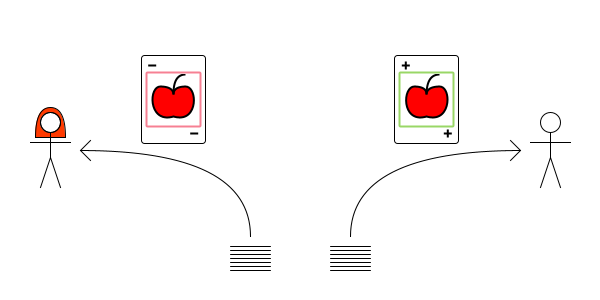
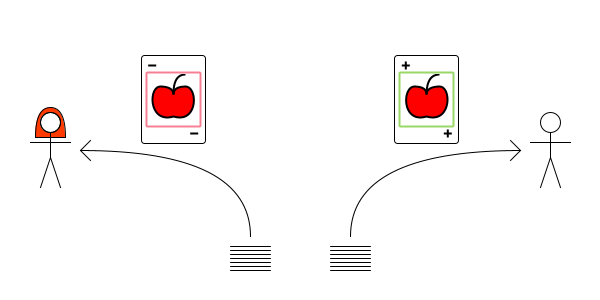
When one player picks up a green card, another player must pick up a pink card, and vice-versa. And both cards must have the same object drawn on them.
When one player discards a green card, another player must discard a pink card with the same object drawn on, and vice-versa.
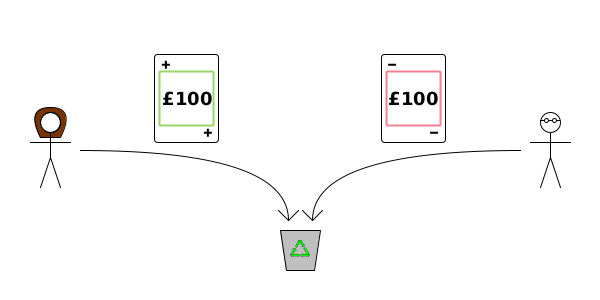
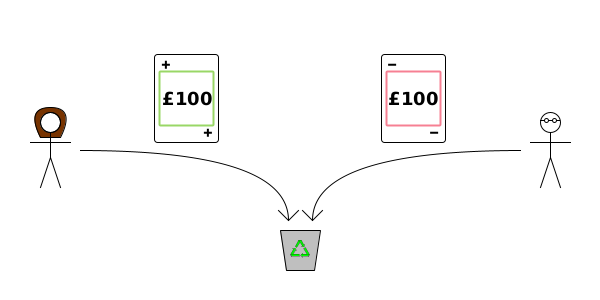
This is just to make sure that any debt which is owed to someone must be owed by someone else, and vice-versa. One-sided debts can’t exist. They just don’t make sense.
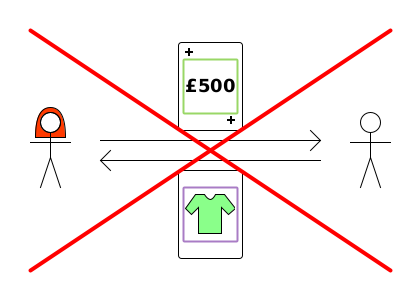
Other restrictions on a player’s actions reflect laws and customs. For example, there have been societies where only a few people were allowed to have silk clothes. In that case, there would be a rule against the other players obtaining purple cards representing silk clothes.
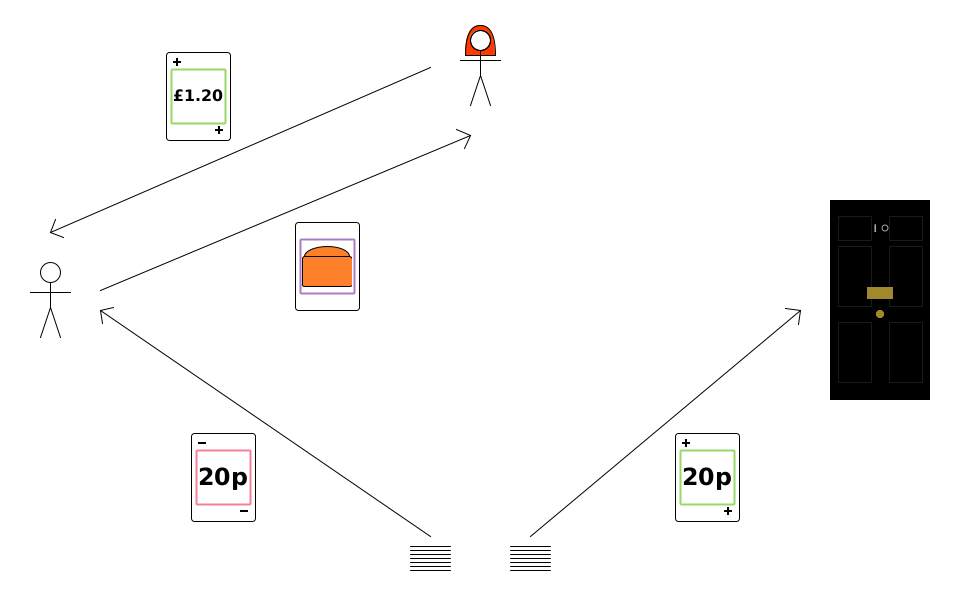
Sometimes there are actions which are allowed, but only if the players perform other actions at the same time. For example, if a society has a 20% Value Added Tax, then one player (the customer) can transfer a green card representing £1.20 cash to another player (a shopkeeper) in exchange for a purple card representing a loaf of bread, but then the shopkeeper must draw a pink card representing 20p (VAT), and the government player must draw a green card also representing 20p, because the shopkeeper is now required to pay 20p tax to the government.
Let’s look at a couple of variants of the 3-deck card game for different societies.
The “corporations” variant
Some societies allow corporations to exist. Those societies pretend that there are extra people who can own, be owed, and owe things — but these extra people are imaginary, so all their decisions and actions have to be taken by real people on their behalf. To understand how this affects the 3-deck card game, let’s first look at what’s probably a more familiar example.
The game of Blackjack uses a standard 52-card deck. To win, a player has to get a higher score (the sum of their card values) than the dealer, but if they go over 21, they automatically lose. They start with 2 cards, and can ask the dealer for extra cards.
The important point here is that there’s an interesting “split” rule. If the player’s first 2 cards have the same value (e.g. both aces), the player can “split” them. That means that the cards are physically separated, and the dealer adds another new card to each. There are now 2 hands where there was 1, and they’re played independently, as though there’s an extra player. But in reality this extra player is imaginary, and “their” decisions are taken for them by the real player who split their cards.
In the 3-deck game analogy, a corporation is also represented by an extra hand, which is controlled by other real players. There are various types of corporation, such as:
A limited liability company (e.g. supermarket J Sainsbury plc)
A government body (e.g. Corporation of London; the UK Government’s Consolidated Fund)
A foundation or trust (e.g. Ford Foundation; Nuffield Trust)
From the perspective of the card game analogy, these different types of corporation are essentially the same. The difference between them is just about who makes decisions on their behalf, and what restrictions there are on the decisions they can make.
From an economic perspective, the key feature of a corporation is that it has its own assets and liabilities (and balance sheet), which is why there is a hand associated with it in the game analogy.
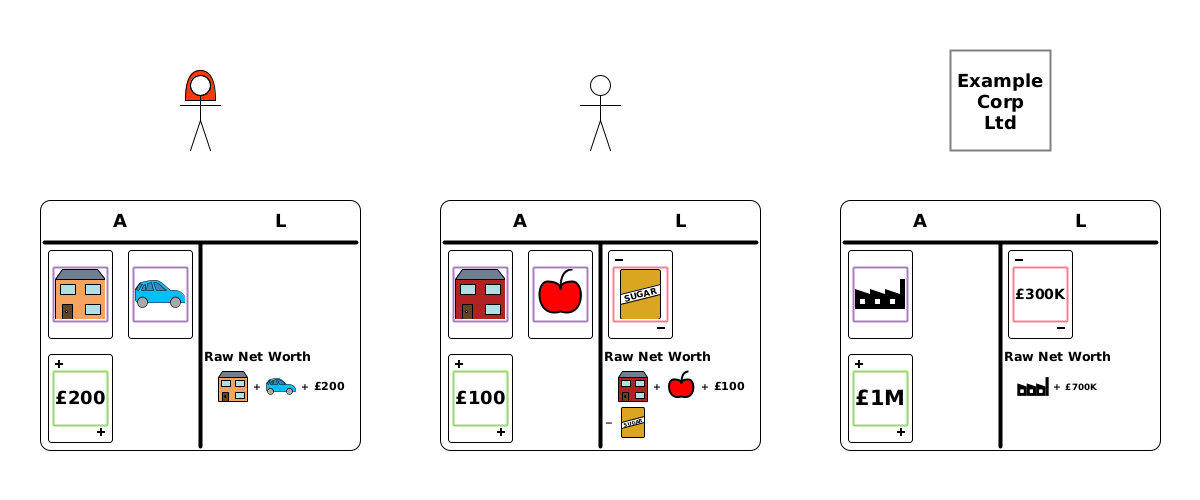
The corporation is an imaginary “player”, which can’t make decisions of its own. Instead, a group of real people make decisions on its behalf. In principle, the decisions could be voted on by everyone concerned, but that’s often completely unrealistic, and a small group of people are usually appointed as directors, government ministers or trustees to make strategic decisions. They in turn delegate detailed decisions to other people who work for the corporation.
The important point is that the corporation’s hand works in the game analogy just like any other player’s hand. It draws cards, gives cards to other players, receives cards from other players, and discards cards.
The “socialism” variant
As I understand it, the defining property of a socialist society is that the “means of production” (tools, machines, factories, etc.) are owned socially. That has two consequences for the 3-deck card game analogy:
Separate hands are created to own the means of production.
Individuals aren’t allowed to buy, or produce for themselves (or for corporations which they exclusively control), the means of production.
That’s pretty much it. The hands containing the purple cards for the means of production could be controlled by regular meetings of citizens, or by regional, national or even global governments. Another possibility is that the employees of the corporation could control it together.
Just like corporations mentioned above, these socially-controlled corporations’ hands work just like any other player’s hand.
Summary
Many economic models make a lot of assumptions about the type of society which they describe. Neoclassical economics assumes that firms try to maximise profits. Marxist economics appears to assume that commodities have an objective value. But I believe that the card game analogy is flexible enough to describe any society without making such assumptions. All it assumes is that:
People exist.
They can own, be owed and owe things.
Corporations can exist. They are like imaginary people: they can own, be owed, and owe things like real people, but their actions have to be controlled by real people.
Anything owed by someone is owed to someone else, and vice-versa.
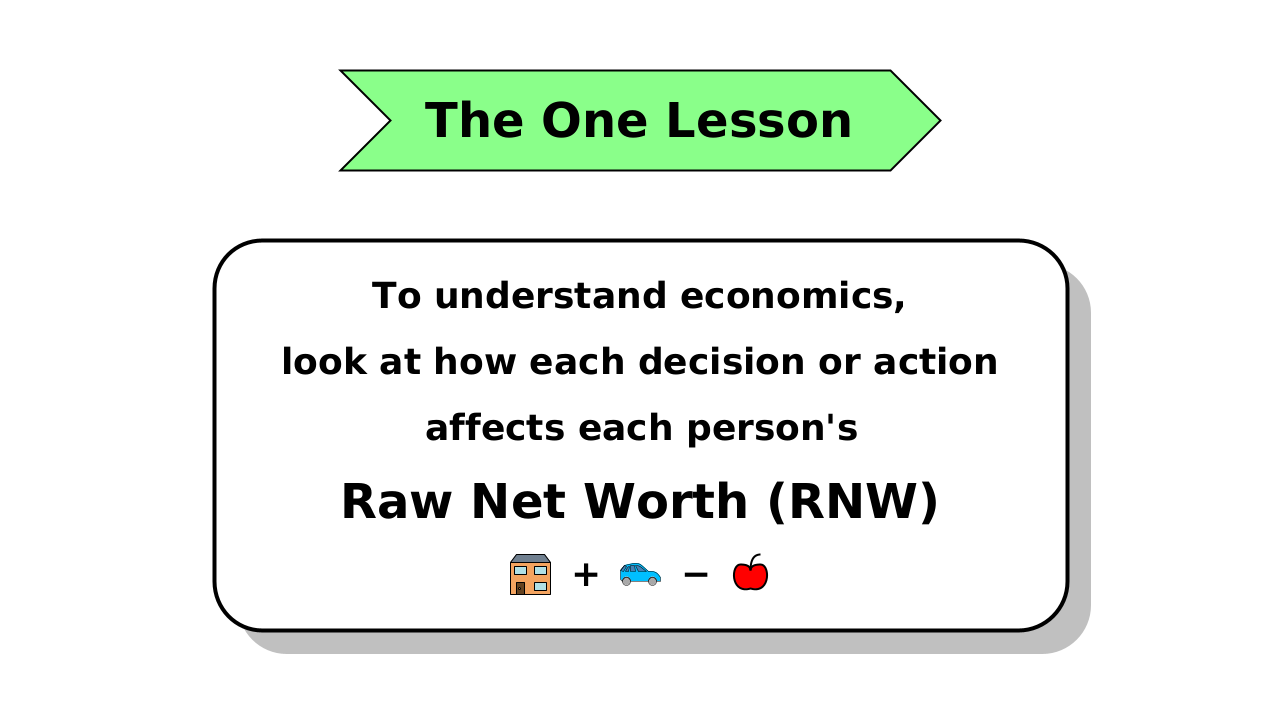
And as always, remember the One Lesson:
The card game analogy works reasonably well for private corporations (they are legal fictions ultimately controlled by shareholders, directors, or owners).
But it seems problematic when extending it to the sovereign government / issuer of the currency.
A monetary sovereign can create its own liabilities in its own unit without ever facing nominal insolvency. This is fundamentally different from a household or firm, which can be forced into default or restructuring even if it has real assets. Why should we treat the issuer the same as currency users when their operational constraints are fundamentally different?