

In case you don’t know, Minecraft is a computer game made by a Swedish company, Mojang. As a player, you see a 3-D world (made of 1 metre cubes) from the perspective of a human character. You start with nothing but your clothes, and have to gather resources, and make tools and equipment, first of all to survive, and then hopefully both to thrive in the world and to overcome some challenges.
In this series, we’ll look at the game from the perspective of economics, and the One Lesson in particular.
Unfortunately, with all the images, this article won’t fit in an email, so please follow the link (click on the title) to make sure you see all of it.
There are no debts in Minecraft, but it’s still a great illustration of production and consumption — both unproductive and reproductive1. It also shows how producing capital (basically tools, but see below) makes all the difference between barely scraping by and thriving.
Start of the game
Here’s an example of what you might see when the game starts.
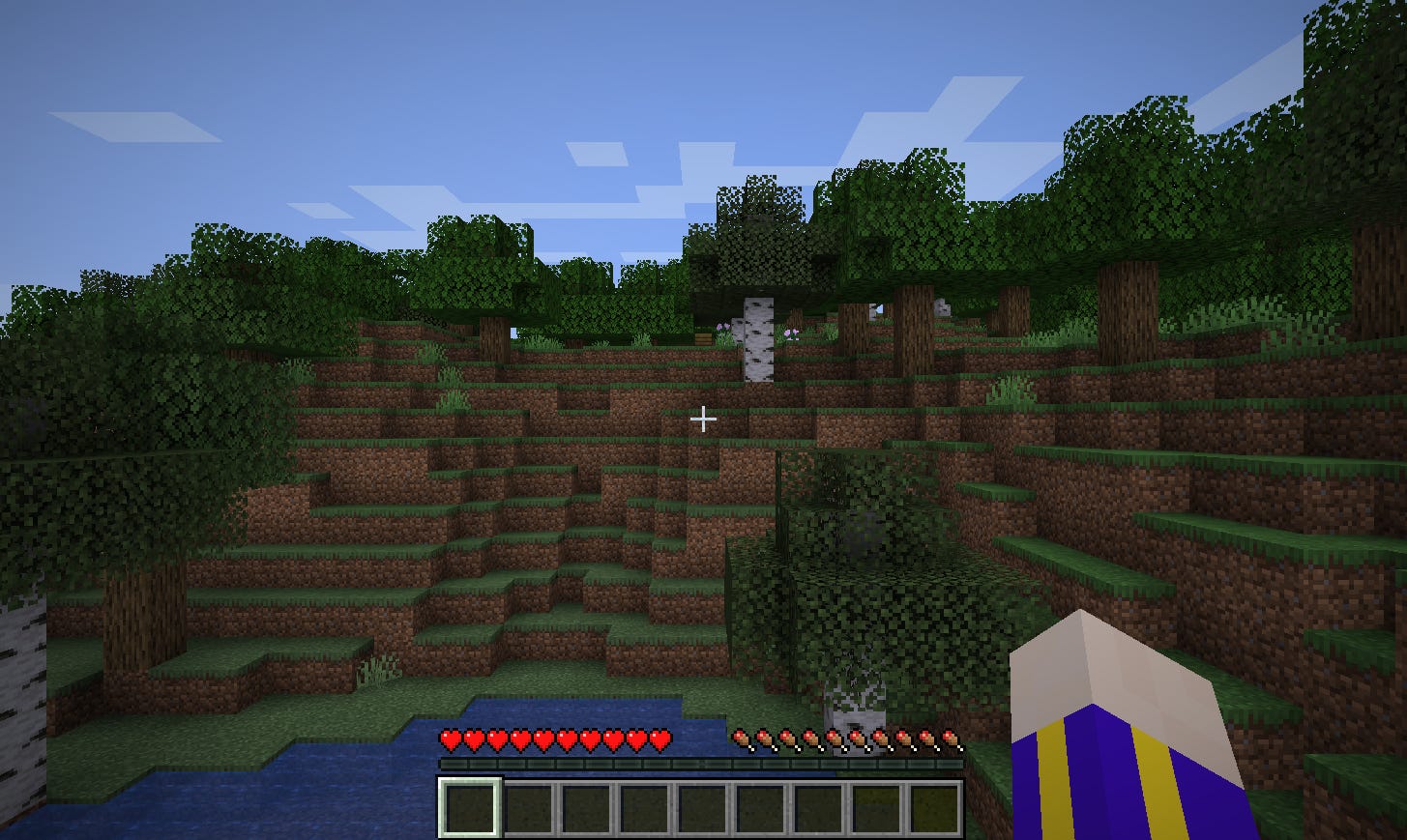
The pink, purple and yellow shape at the bottom-right is the character’s right arm, ready to punch things.
The 9 grey boxes at the bottom (“hotbar”) show the things you’re carrying which you can most easily access2. You can see you start with nothing. Apart from your clothes, you have an empty balance sheet: you own nothing, are owed nothing and owe nothing.
Notice the rows of hearts (“health bar”) and drumsticks (“hunger bar”).

If you take damage, you lose hearts from the health bar. And if it drops to zero, your character dies.
If you don’t eat, you lose drumsticks from your hunger bar. When your hunger bar is near-full, you actually gradually recover health, but if it’s empty, you keep taking damage until you eat again (or die).
So to survive, you need to get food to eat, and avoid taking damage. But not taking damage is easier said than done, especially when the sun sets and this lot start “spawning” (appearing out of nowhere):
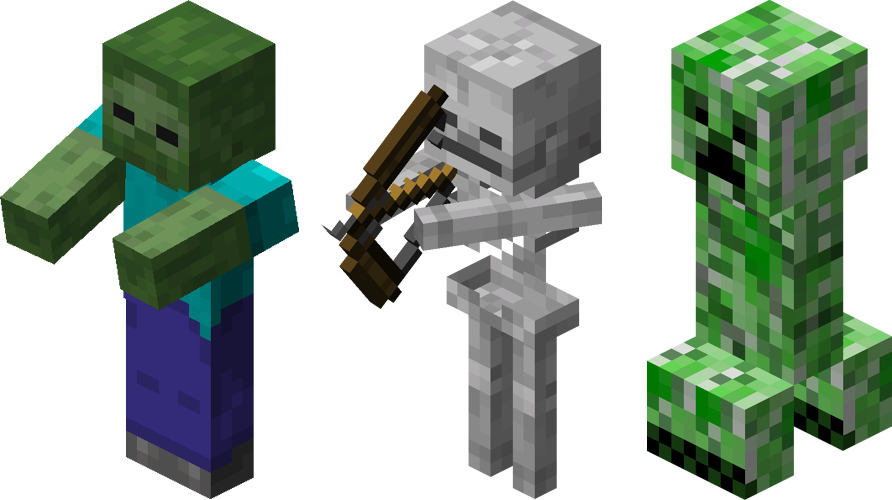
Zombies punch you, skeletons shoot arrows at you, and creepers approach you quietly and then explode!
So the top priorities are finding some food and getting some shelter to keep away from the hostile mobs3. And that’s where economics comes in. You have to produce things to satisfy your needs for food and shelter. How do you do this?
How to produce things (“factors of production”)
Economists talk about the “factors” of production. It might sound like it’s a complicated idea, but it just means the types of thing you need in order to produce things:
Land. Anything from the physical world in its natural state. (Stone, trees, sand, ores, water, plants, etc.)
Labour. People using their bodies to manipulate the world around them. (Picking berries from a bush, sharpening a stick, weaving willow branches together, typing software code, etc.).
Capital. Things which you’ve produced in the past which help you to produce other things in future. (Nets, saws, axes, knitting needles, buckets, computers, cranes, etc.)
Entrepreneurship. Organising other factors when your production requires a complex process. (E.g. to set up a pin factory, someone has to get the use of a building, bring together a group of people, assign them tasks, and provide them with tools, so that they can convert the inputs of wire and paper into the output of packs of pins4).
Which of these factors do you need in Minecraft to get food and shelter?
Well since both food and shelter are physical, you’re going to need land.
You’re not going to be setting up a complicated production process at first, so you won’t need entrepreneurship.
Food and shelter won’t magically appear if you just stand around and do nothing, so you’re definitely going to need labour.
What about capital? For now, let’s see how well you can get on without it, using just land and labour.
Land ✅
Labour ✅
Capital ❌ (for now)
Entrepreneurship ❌
Surviving Minecraft without any capital
Shelter
Shelter is usually the easier need to satisfy.
After 10 minutes of playing, the sun starts setting5.
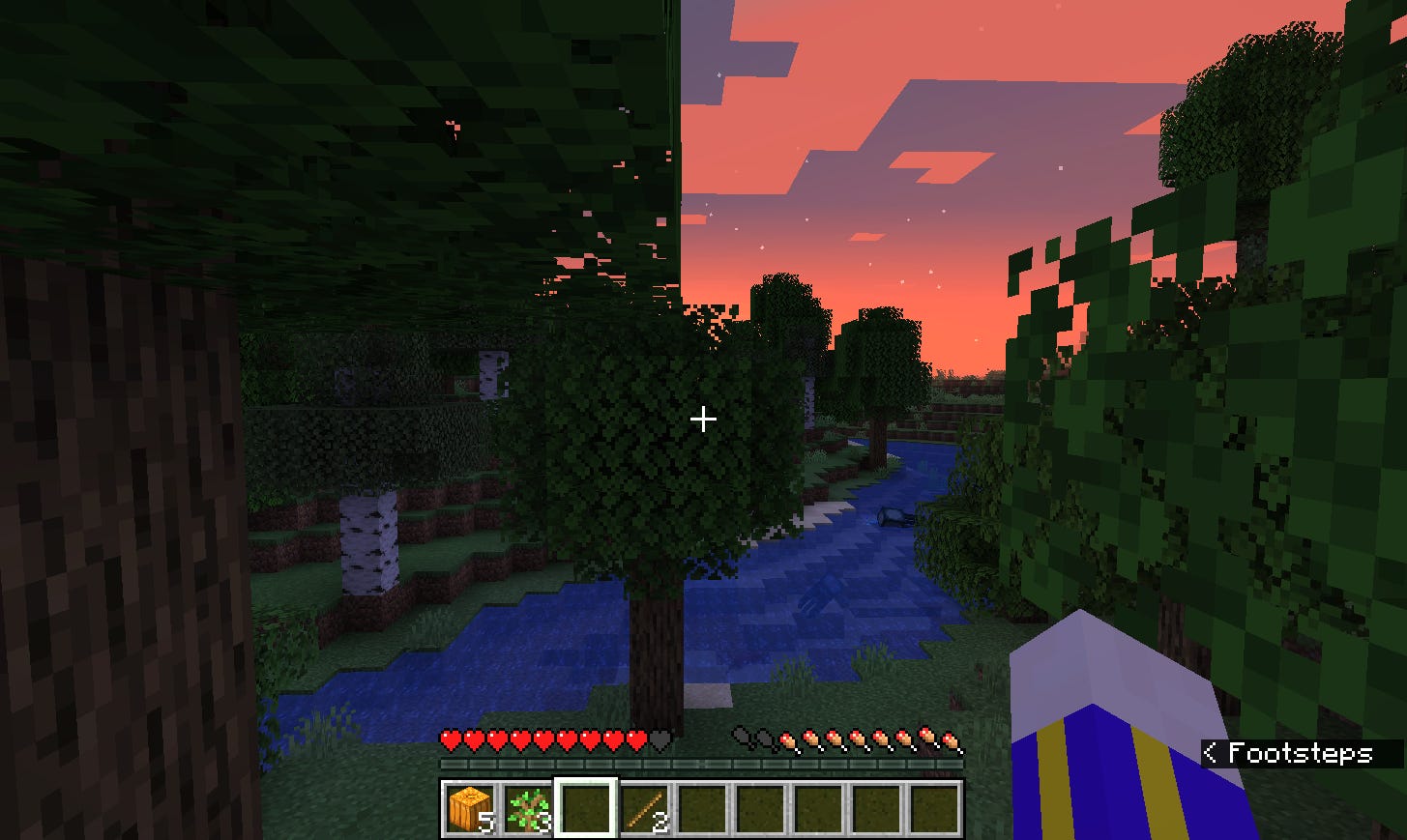
To keep away from the hostile mobs which are about to spawn, you can make a simple dirt shelter. By punching a block of dirt with your bare hands for a few seconds, it eventually “breaks”: the game replaces it with a cubic metre of air, and leaves a floating block (called an “item” in Minecraft) of dirt in its place which you can pick up just by standing next to it.
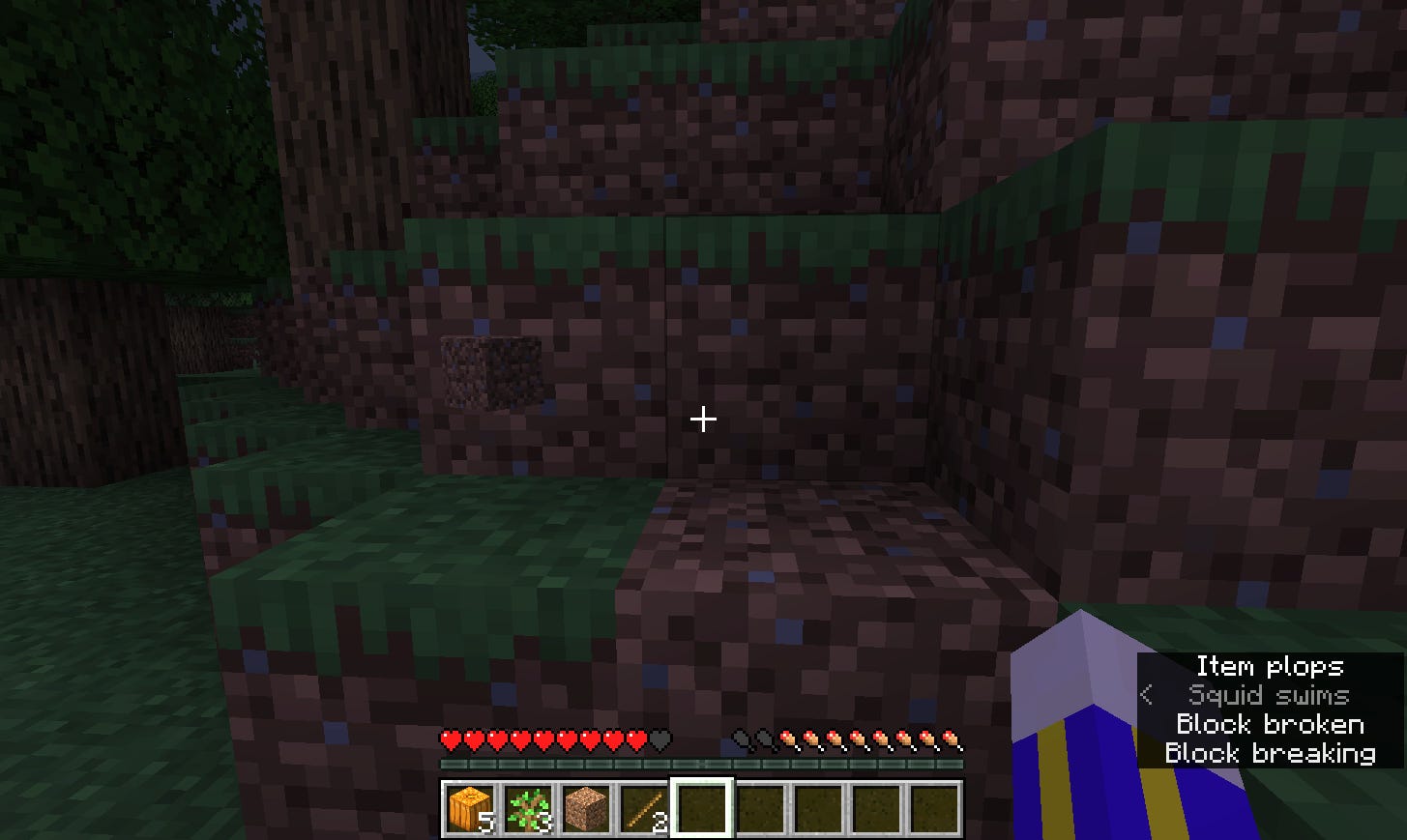
You can then place the dirt block where you want in the landscape. So you can find a hillside, dig a short 2m high tunnel in it with your bare hands, and place the blocks behind you so you’re completely enclosed on all sides.
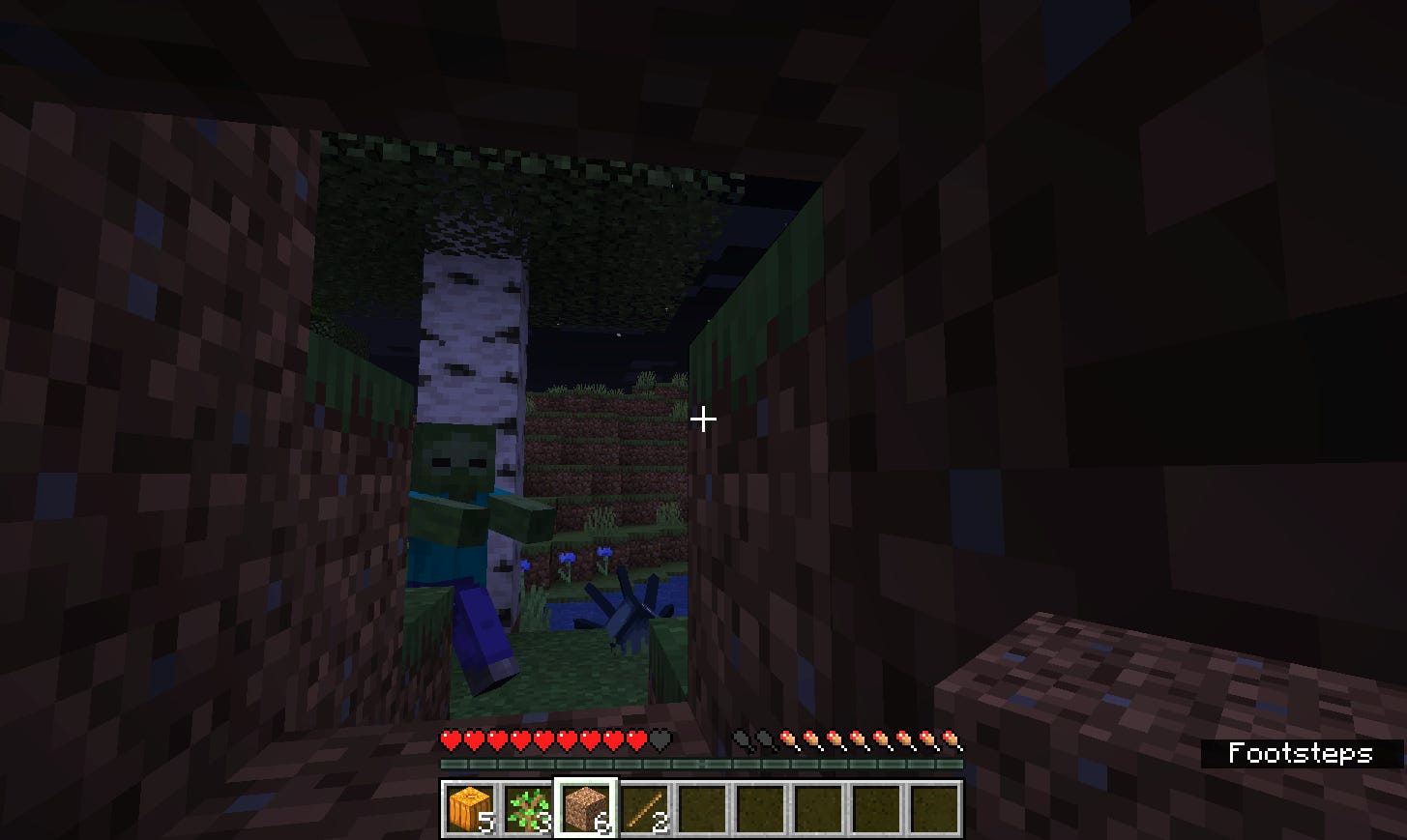
Then you wait in the pitch black for sunrise. Again, this is about 10 minutes of time in the real world. A bit boring, to say the least.
At sunrise, the zombies and skeletons which are exposed to the sun burn up, so after a few seconds, it’s safer to come out6 and concentrate on your other need: food.
Food
There are a few ways to get food even if you don’t have any capital. It’s basically a hunter-gatherer lifestyle.
Raw meat
If you aren’t put off by the animal cruelty involved, there are various wild animals which you can punch to death, and they leave behind raw meat items which you can pick up and eat (but they might give you food poisoning).
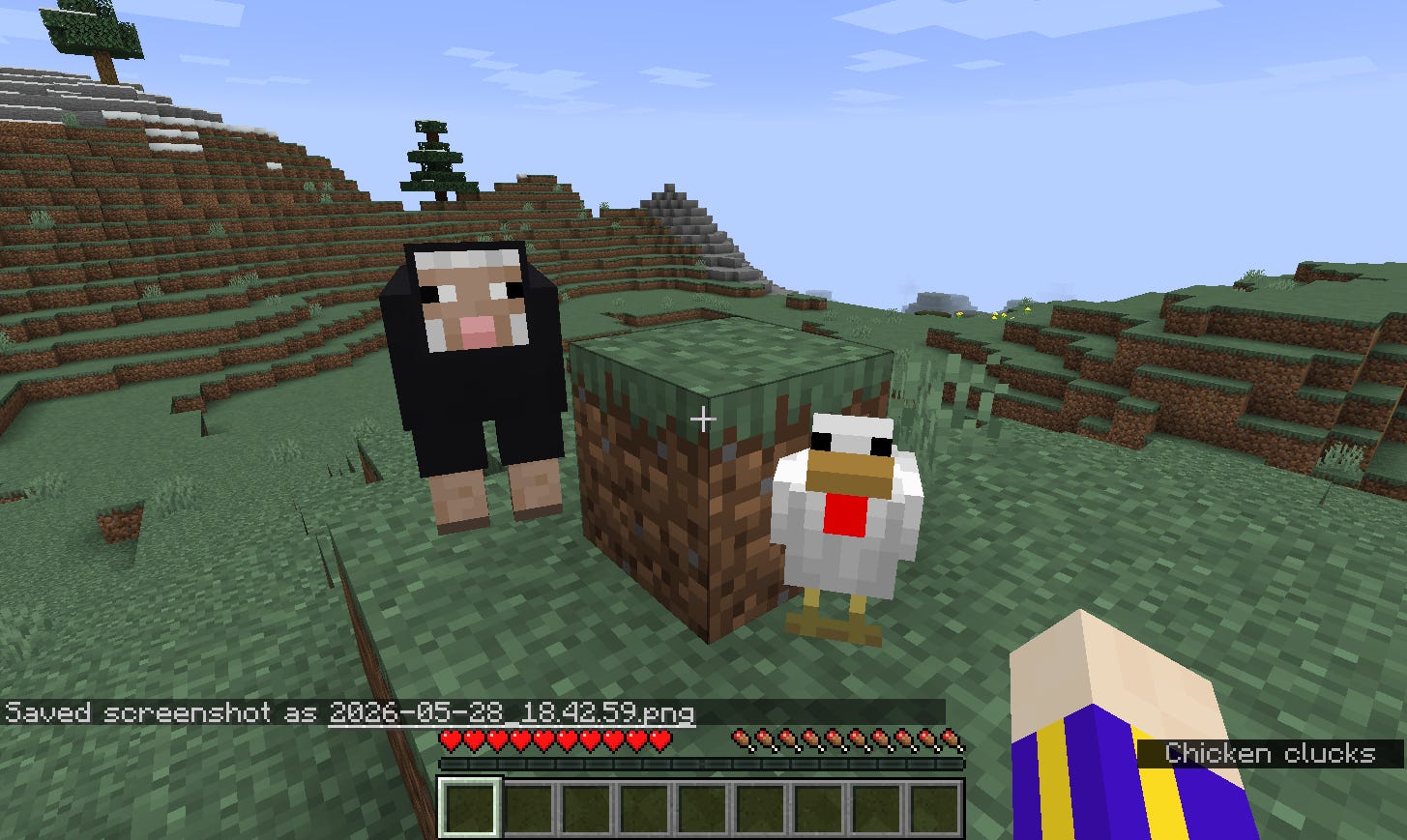
If you can’t stomach doing this, but are desperate for meat, there’s an (unpleasant!) alternative.
Rotten flesh
When a zombie burns up in the sun, it leaves behind some rotten flesh. It will probably give you food poisoning, but it adds a bit to your hunger bar anyway.
Other than these, there are some vegetarian options:
Apple
If you punch the leaves of an oak(!) tree, it will break after a few seconds, and occasionally drop an apple item, which you can pick up and eat.
The leaves don’t grow back, but punching the leaves sometimes drops an oak sapling, which you can plant. It eventually grows into a new oak tree with new leaves to punch.
Pumpkin pie
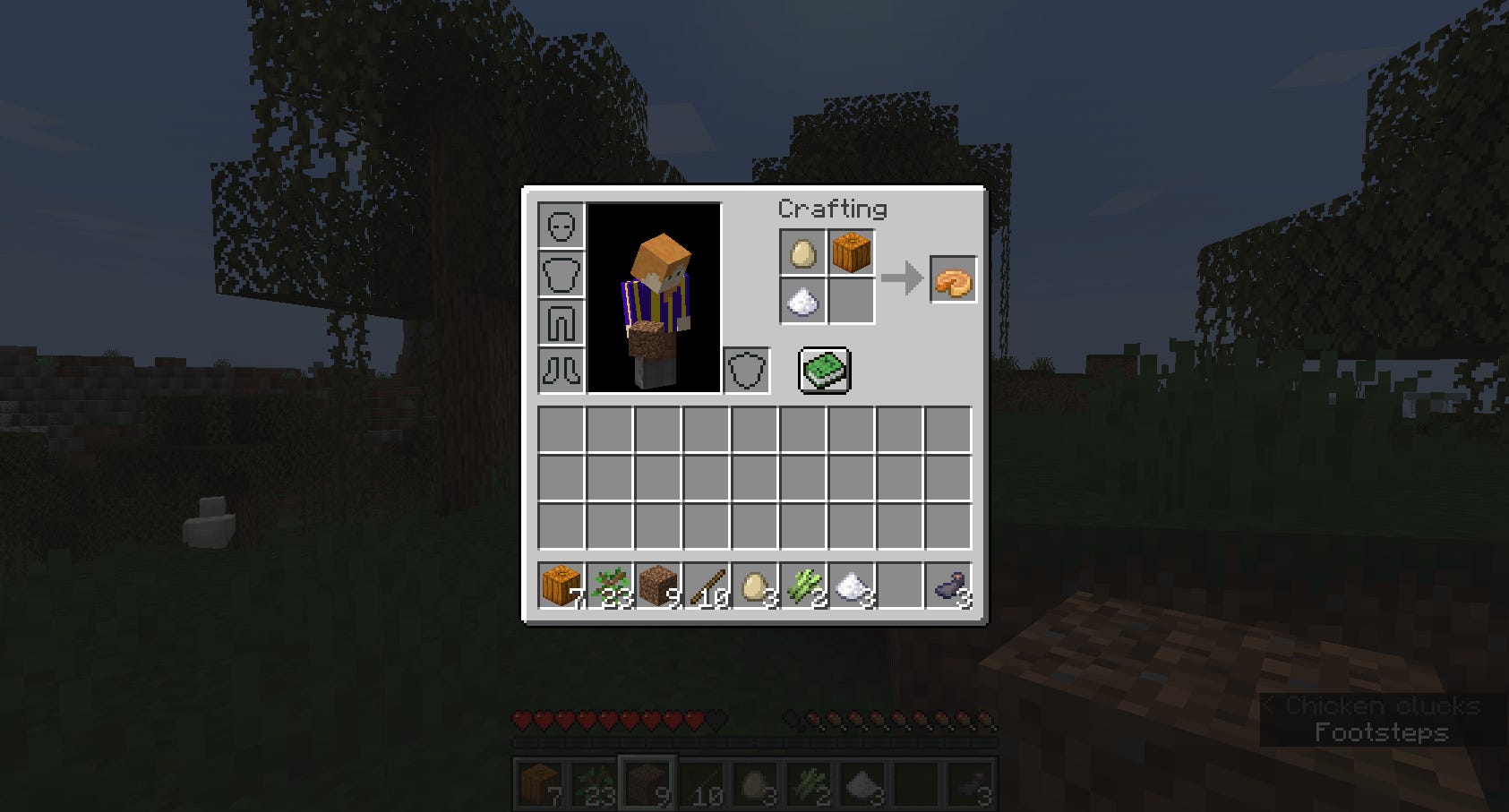
If you can find a pumpkin, some sugar cane, and an egg item (which chickens regularly leave around), you can make a pumpkin pie. You punch the pumpkin until it breaks and you can pick it up.
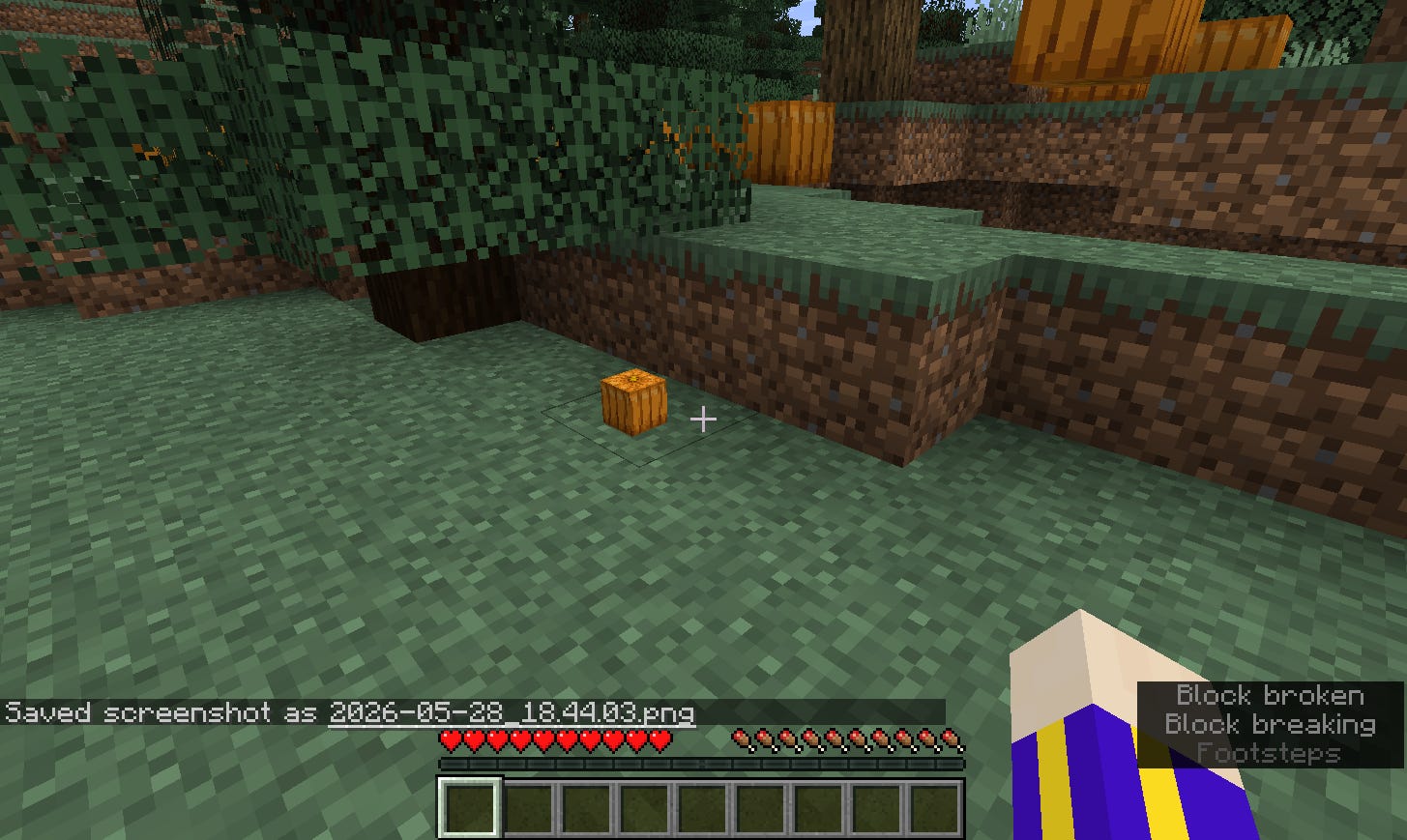
You do the same with the sugar cane. You can then combine them with the egg to make the pumpkin pie7. This is very nutritious.
Pumpkins which grow wild in Minecraft don’t have stems, so once you’ve taken one, it won’t grow back, and you’ll have to keep searching in other places to find new food. But sugar cane grows up to 3m tall, and as long as you only break it above the bottom 1 metre (or you replant it next to water), it will continue to grow and you can keep harvesting more.
Sweet berries
If you find a sweet berry bush, you can right-click on it to collect the sweet berries growing on it. You can eat these.
Better still, any you don’t eat can be planted in the ground, and each one creates a new sweet berry bush, so you can create a renewable food source, and should never go hungry again.
Water melon
If you find a water melon, you can punch it to get a few water melon slices, which have a bit of nutrition.
Like pumpkins, the water melons which grow wild don’t have stems, so once you’ve taken one, it won’t grow back.
Minecraft and the One Lesson
The One Lesson of this blog is this:
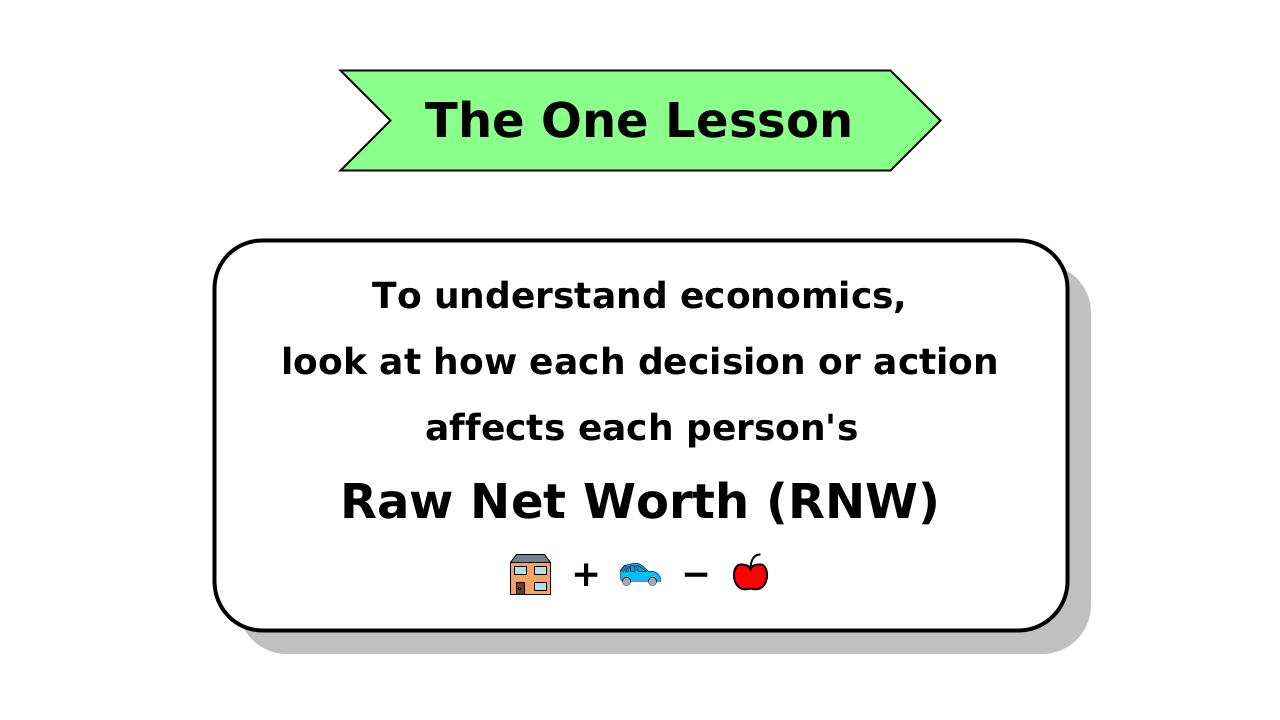
Someone’s Raw Net Worth (RNW) is what they own + what they’re owed - what they owe. It’s not some monetary value. If the idea is new to you, this article explains it with examples.
Production
When you harvest an apple from a tree, it’s a type of production. Before punching the leaves, you didn’t own the apple (and neither did anyone else), and afterwards, you do. Here’s how we can represent that with a diagram showing the player’s RNW increasing by one apple (and nobody’s decreasing):

The diagram is the same when you break and pick up a dirt block, but obviously with the apple replaced with dirt.
Consumption — unproductive
Eating sweet berries is a type of consumption. Before eating, you own the sweet berries, and afterwards you don’t (and neither does anyone else): your RNW decreases by the berries, shown by the arrow pointing away from the player.

Again, the diagram would be essentially the same for placing a dirt block back in the landscape.
Consumption — reproductive
Some production needs you to consume something in the process. To make a pumpkin pie, you have to use up a pumpkin, some sugar and an egg. Before this you owned the 3 ingredients, but didn’t own the pumpkin pie (and neither did anyone else). Afterwards you don’t own the ingredients (and neither does anyone else), but you do own the pumpkin pie. So you’ve consumed the ingredients, and produced the pumpkin pie.
To represent this, we have two arrows:
one pointing away from the player, representing consumption of the 3 ingredients, and
one pointing towards the player, representing production of the pumpkin pie.
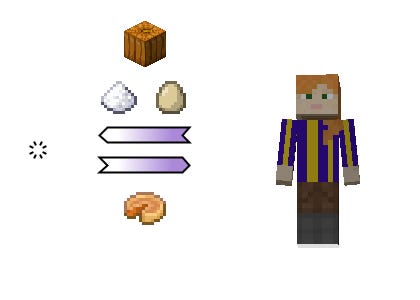
From the arrows, we see that the player’s RNW has decreased by the pumpkin, the sugar and the egg (arrow pointing away from the player), and increased by the pumpkin pie (arrow pointing towards the player).
Summary
You can just about survive in Minecraft using only the land and your labour. But it’s a precarious existence. You spend half your time awake at night in a tiny shelter, listening to the hostile mobs wandering around outside, and the rest of the time you have to spend searching for food.
In an upcoming article, we’ll see how producing capital revolutionises the game play, just as it revolutionised real life. The technology available to you improves rapidly, building on your previous advancements, so you can thrive instead of barely surviving, and be equipped to take on some much bigger challenges.
Reproductive consumption is where something is consumed as a necessary part of the process of producing something else.
You can also carry 27 other items, or groups of items, which are a bit slower to access.
‘Mob’ here is short for “mobile object”, and means a character controlled by the game itself, not by a player. It’s a type of “NPC” (non-player character).
Adam Smith described this example right at the start of The Wealth of Nations (Book 1, Chapter 1). As I’ve said before, I think everyone should read at least the first few chapters. PDFs are freely available online. It’s written for normal people, not for economists, and even though it’s 250 years old, it’s not hard to understand.
A complete day-night cycle in Minecraft takes 20 minutes of real world time.
But definitely not safe! Creepers don’t burn up in the sun. (They despawn at random some time later). Neither do skeletons or zombies which either have a helmet, find shelter, or get into water.
In fact you first have to produce sugar from the sugar cane; then you use the sugar with the pumpkin and egg to make the pumpkin pie.
Great illustration of the economics in Minecraft! I like the game, the Long Dark. Also a survival game, with a similar survival mechanic.
It makes me also wonder about how realistic some games economic systems are as opposed to others. For example, civilization feels very top down, very command and control. You are in charge of everything.