

In the last article, we saw that it’s just about possible to survive indefinitely in Minecraft without creating any capital (that is, products which you use to make other products). But it’s a precarious existence. Unless you discover some sweet berries, you have to be constantly exploring new places to find food. And even if you manage to stay fed, you’re always in danger of death from a long fall, a couple of shots from a skeleton’s bow, or a creeper exploding next to you.
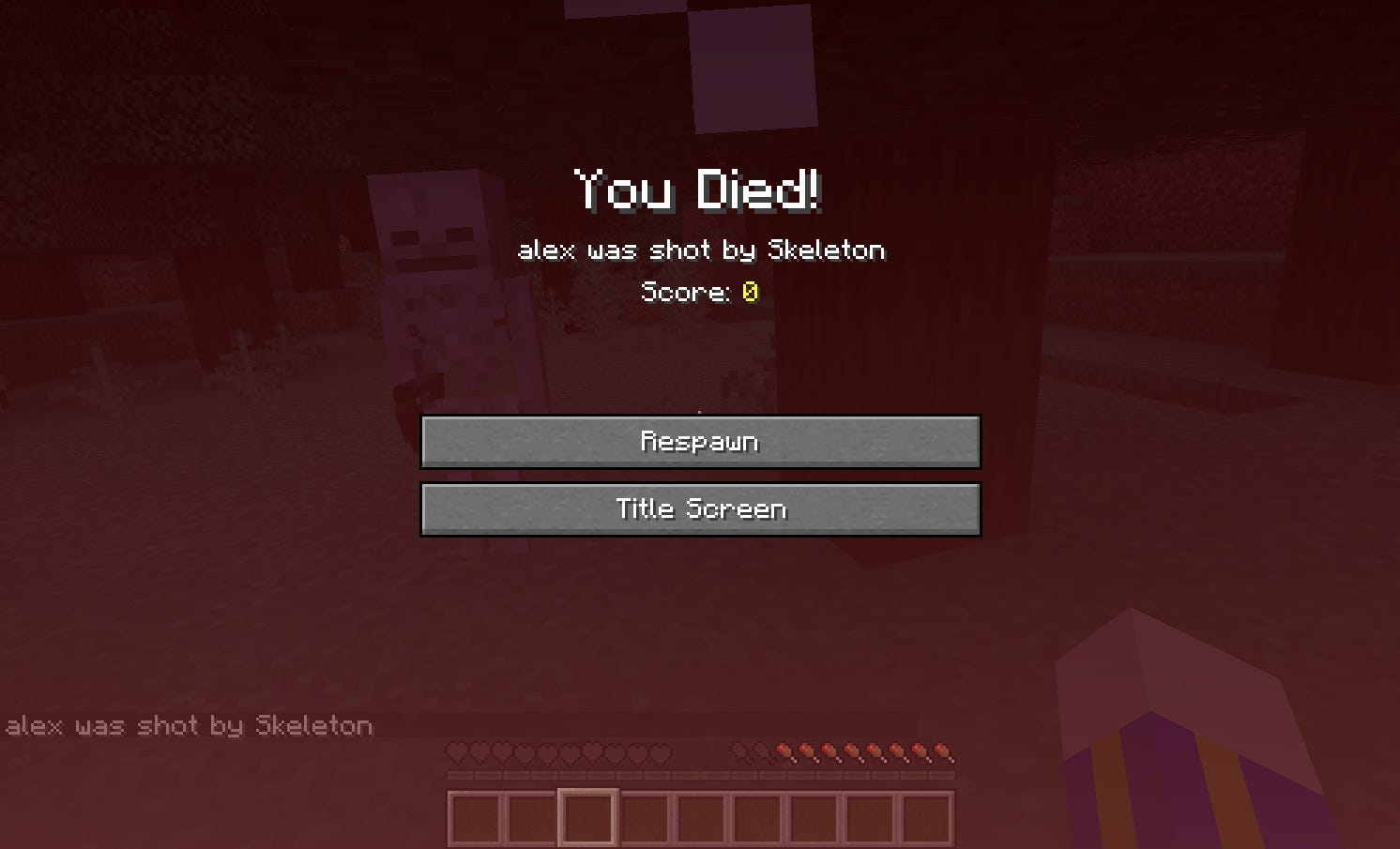
In this article and the next, we’ll see how creating capital improves your position beyond all recognition, not only for food and shelter, but also for surviving dangers, exploring the world, and overcoming challenges.
Unfortunately, with all the images, this article won’t fit in an email, so please follow the link (click on the title) to make sure you see all of it.
While the actual details of technologies in Minecraft are a bit quirky (often in a fun way), the overall lesson from it very much applies to the real world:
Capital can increase your productivity by many orders of magnitude, so you can create an abundance of wealth.
In some cases, using capital lets you do things you simply can’t do with labour alone, no matter how much time you spend on it.
You can often use basic capital to help you to create more technologically advanced capital, which provides even bigger productivity increases. And you can chain this technique, with each generation of capital being more advanced, increasing productivity more than the previous one.
Your very first capital: the crafting table
Last time, we saw that you can manufacture simple products by combining up to 4 items1 from your inventory (in a 2×2 grid). But this isn’t enough to make most of the tools which exist in Minecraft. For those, you need to be able to combine up to 9 items (in a 3×3 grid), especially as you often have to put the items in the right places in the grid2. To do this, you need a crafting table — you can think of it as a sort of workbench.
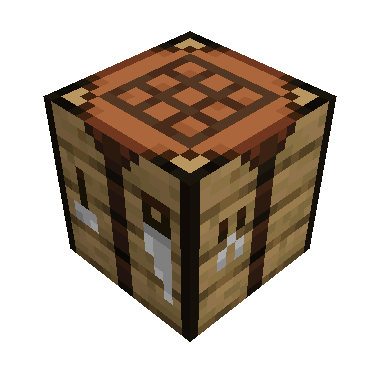
A crafting table is a type of capital. You don’t make it to consume it, but to make other products with it.
Fortunately you can make a crafting table without needing to use an existing crafting table, otherwise you’d be stuck. To manufacture one, you combine 4 planks of wood, which you can get from a single wooden log. And to get a log, you just need to punch a tree until that part of the trunk breaks, and the log item drops for you to pick up.
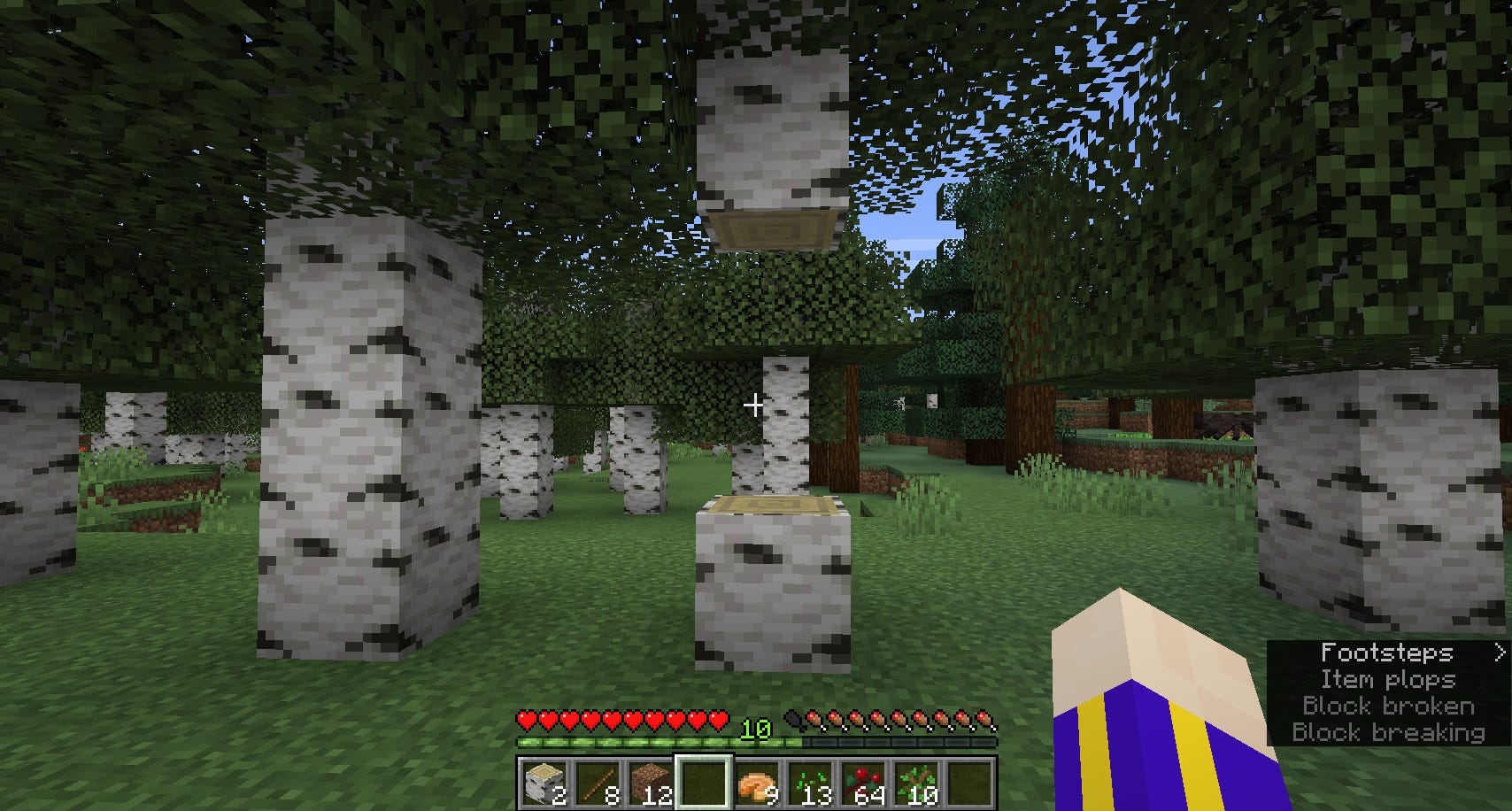
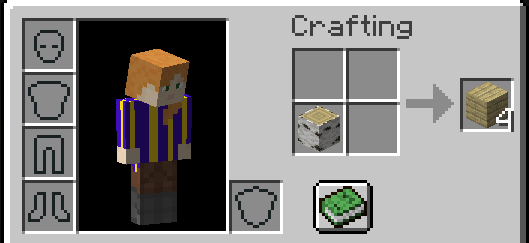
With a log, you can create 4 planks:
And with the planks, you can make the crafting table:
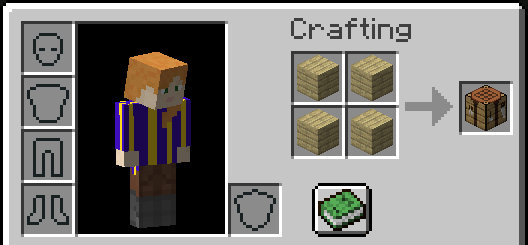
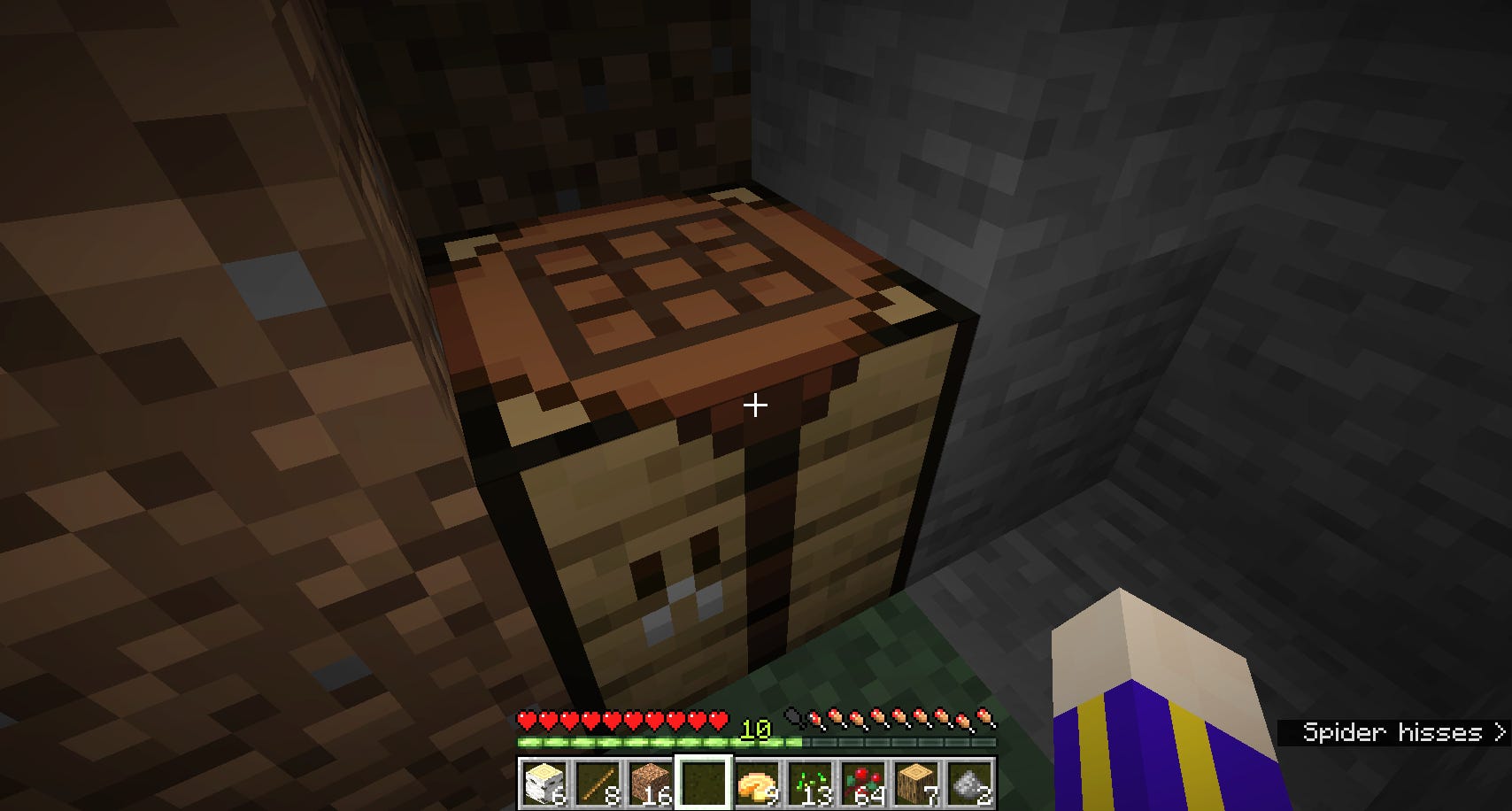
You then place the crafting table somewhere convenient:
Farming for food
Now that you have a crafting table, you can start manufacturing some tools. This lets you start farming, so you don’t have to keep exploring new places just to get food. To grow most types of food, you first have to till the ground with a hoe.
At this stage, the only material you can use for tools is wood: you need sticks3 (for the handle) and planks (for the head).
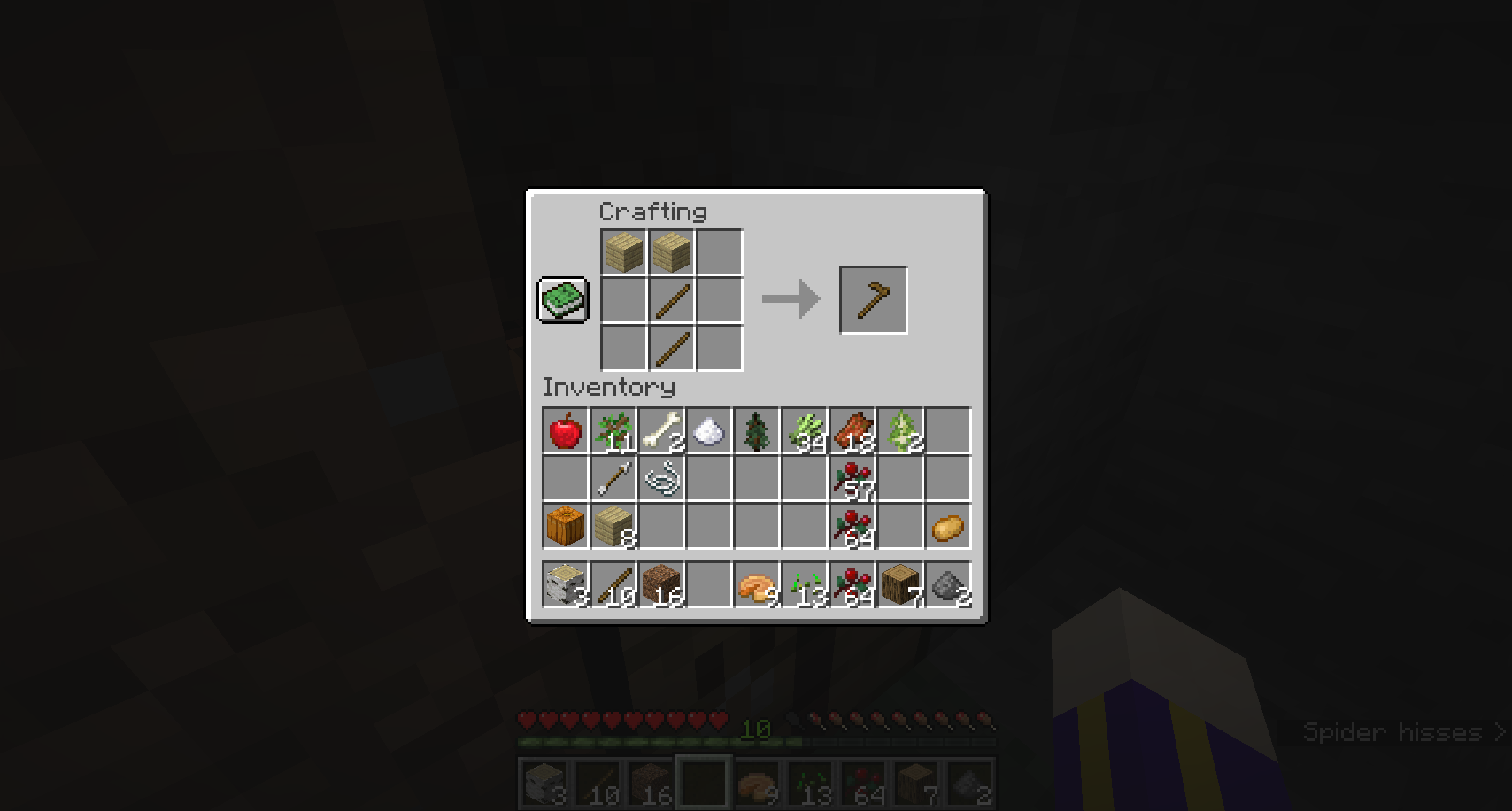
You can make a wooden hoe from 2 sticks and 2 planks, like this:
Then you just need to find some dirt or grass blocks near to water, use the hoe on them, and then plant seeds (wheat4, melon, pumpkin, beetroot) or vegetables (potato or carrot) in the tilled land.
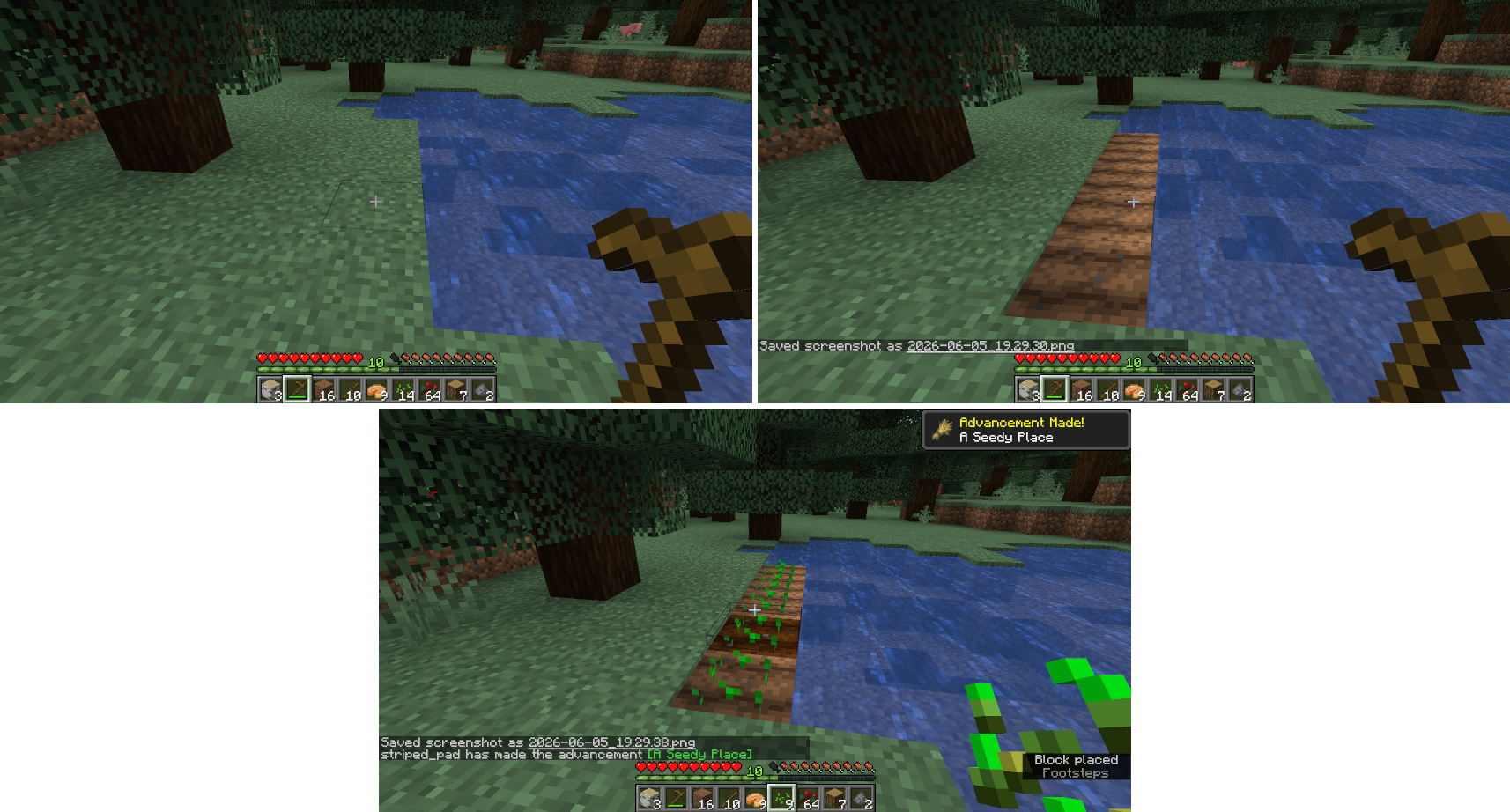
It takes a few Minecraft days for plants to ripen. Then you can harvest them simply by punching them5.
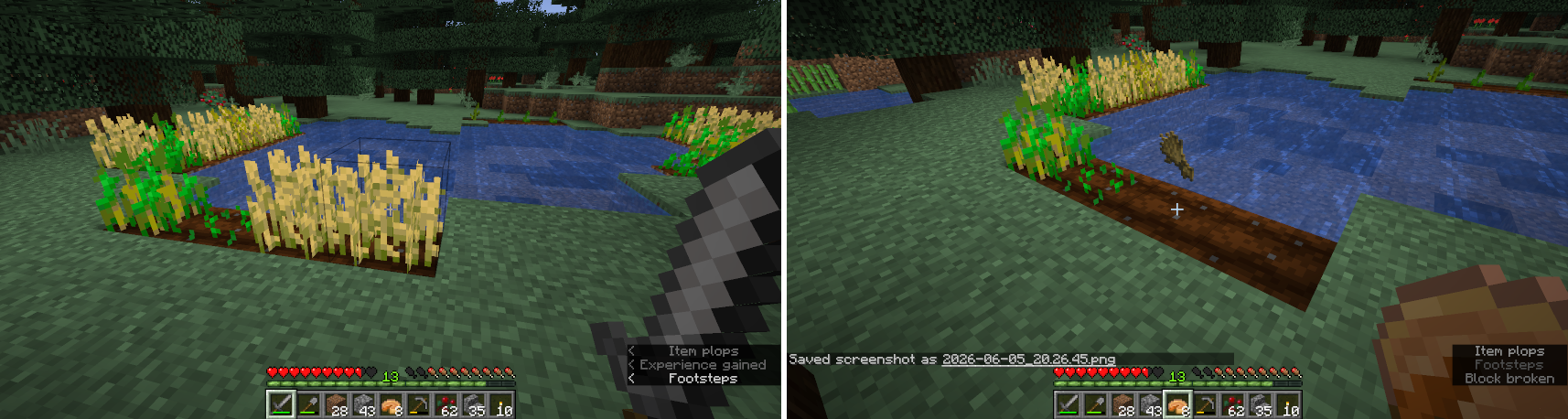
Once you have 3 wheat items, you can combine them on a crafting table to make a loaf of bread, which is a good source of food. You only need a fairly small farm to produce all the food you’ll need in the game.
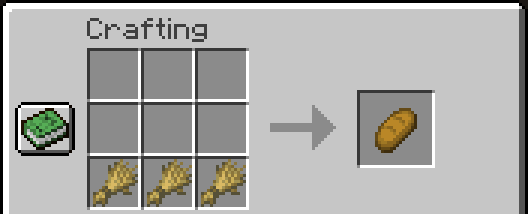
When you harvest wheat, new wheat seeds drop too (not shown above), so not only can can you replant where you just harvested, you can actually increase the amount of wheat you’re growing: farming is more than self-sustaining once you get started.
Arrow Diagrams
To finish this article, let’s look at the arrow diagrams for this economic activity, showing the changes in everyone’s Raw Net Worth6.
One thing I’d like you to get from this, and from all my articles, is that it really is straightforward to understand economics in terms of what everyone owns, is owed and owes. Most people’s intuition about how the economy works actually corresponds directly to this formal, mathematically-rigorous economic model. This close relationship makes the One Lesson approach uniquely grounded in reality. All the theories of economics which I know of can at times become so detached from the real world that they reach absurd conclusions, like it being “good for the economy” to smash windows.
Producing a crafting table
![[1] (P) void→player {log}. [2] (C) player→void {log}. (P) void→player {plank ×4}. [3] (C) player→void {plank ×4}. (P) void→player {crafting table}](https://substackcdn.com/image/fetch/$s_!JV09!,f_auto,q_auto:good,fl_progressive:steep/https%3A%2F%2Fsubstack-post-media.s3.amazonaws.com%2Fpublic%2Fimages%2Faecdf504-c551-4e31-aec0-10a386938f3f_640x540.png "[1] (P) void→player {log}. [2] (C) player→void {log}. (P) void→player {plank ×4}. [3] (C) player→void {plank ×4}. (P) void→player {crafting table}")
This diagram shows the 3 stages needed to produce a crafting table:
Punching a tree to get a log (produce log)
Converting a log into 4 planks (consume log, produce planks)
Converting 4 planks into a crafting table (consume planks, produce crafting table).
We can see from the diagram that, overall, the player’s RNW increases by a crafting table. (The other increases to their RNW from production are cancelled out by the decreases to their RNW from consumption).
Producing a hoe
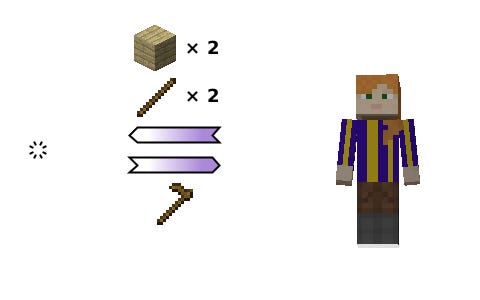
Here, the player consumes 2 planks and 2 sticks in the process of producing a wooden hoe. Their RNW increases by: - 2 planks - 2 sticks + wooden hoe.
Sowing seeds
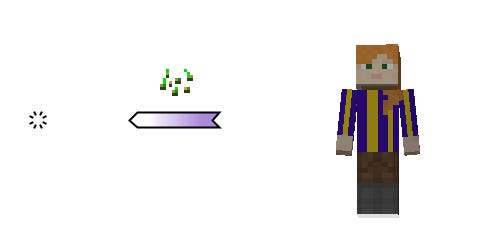
At this stage, the player just loses the wheat seeds. The hoe is needed to be able to sow the seeds in the first place, but isn’t consumed7.
Technically, the seeds in the ground are a form of capital, so we could represent this with a production arrow for the newly-growing wheat plants, and a corresponding consumption arrow for the wheat plants at harvest time. Whether to show this level of detail is a matter of judgement, and I decided not to here. What’s most important is that we understand what’s going on: that sowing a crop gives you a reasonable expectation of being able to harvest later.
Harvesting wheat
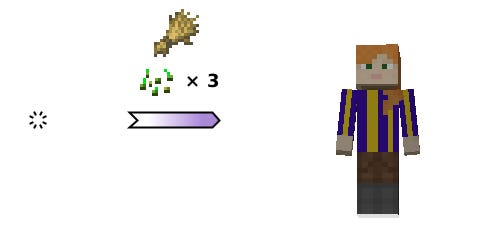
Harvesting one square metre of a ripe wheat plant produces one wheat item, and a random number of seeds. In this case, combining the sowing and harvesting stages, the player’s RNW increases by: - seed + wheat + 3 seeds = + wheat + 2 seeds. The player is unambiguously better off than they were before sowing.
Making bread
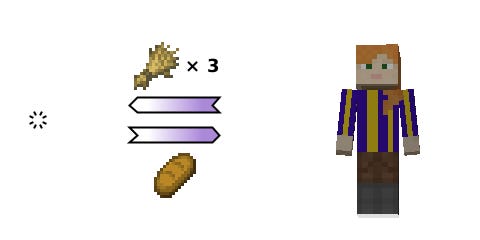
You can use a crafting table to produce bread from 3 wheat items. The player loses 3 wheat items, but gains 1 bread item.
Even though it’s not shown in the arrow diagram, the crafting table is a necessary part of producing the bread, even though it isn’t consumed. The arrows show what actions happen, not how they are able to happen.
Summary
Using capital revolutionises the experience of playing Minecraft, just as it has revolutionised real life. It lets you produce vastly more with a given amount of labour, and even lets you produce things which would be impossible without it.
The capital is used in the production process, but generally it isn’t consumed in the way that raw materials are.8
Capital is used to produce other things. Sometimes those are things to consume, such as using a hoe (at least indirectly) to produce wheat for bread. Other times you’re using the capital to produce more capital, such as using a crafting table to create a hoe.
In the next article, we’ll see how it’s possible to advance technologically by repeatedly using the capital you have in the process of making better capital.
Thanks for reading!
In that case, it was 3: a pumpkin, sugar and an egg to make a pumpkin pie.
Different arrangements of the same items can produce different products. The arrangement often resembles the product you’re manufacturing.
You can make 4 sticks from two planks.
If you punch long grass, there’s a chance it will drop wheat seeds.
In some cases, you might get better results from using a tool.
Someone’s Raw Net Worth (RNW) is what they own + what they’re owed - what they owe. It’s the key idea which makes economics extremely intuitive. If the idea’s new to you, this article explains it with examples.
Although it does gradually wear out. This is one reason to use better, more durable, capital, as we’ll see in the next article.
Capital does often gradually wear out, which is a form of consumption. That needs an article of its own to explore. In fact, we’ll see that a Minecraft anvil is a good illustration of this.