

As we’ve seen in this series, Minecraft illustrates some ideas from economics very nicely. We’ve looked at:
Factors of production (land, labour, capital, entrepreneurship) and the limits of labour without capital,
The huge increase in productivity from producing capital, and
Advances through generations of technology, creating ever-better capital.
But most capital doesn’t last forever.
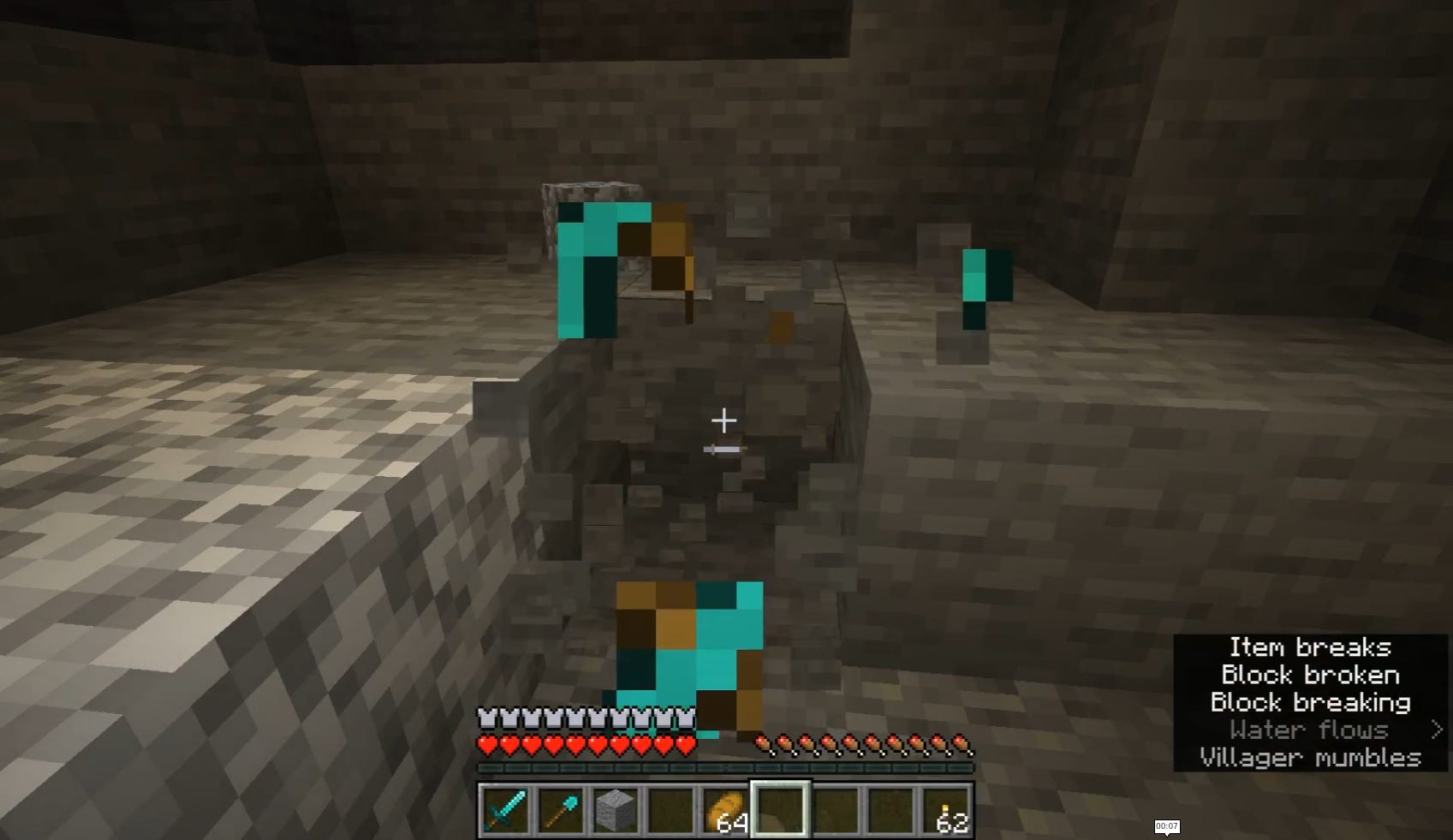
In this article, we’ll see how Minecraft illustrates the idea of wear and tear.
Capital consumption
When capital wears out, this is known as capital consumption. Usually it doesn’t jump straight from being pristine to being broken. Instead, it wears out gradually, perhaps over as little as a few hours or days, but it could be over decades or even longer. How can we represent this when it comes to the idea of Raw Net Worth (RNW)1?
There’s a clue in the name “capital consumption”. The One Lesson has a “Consume” action. But that always means the object is completely destroyed, not just slightly worn out. If you have, say, a car, and it’s consumed, you no longer have the car at all. That’s not what’s happening with gradual capital consumption.
Fortunately, Minecraft has a great example of capital consumption which will help us to think about this problem: the anvil.
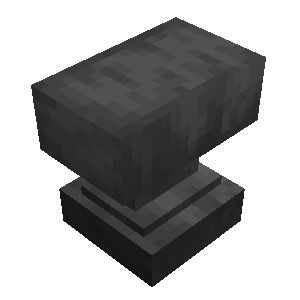
You can make an anvil out of iron. There are various ways you can use it in Minecraft, such as repairing other items (e.g. tools, armour, weapons), or simply giving a name to an item. But each time you use it, there’s a chance2 that it will partly wear out. It deteriorates through the following sequence:

Suppose you have a pristine anvil, and while you’re using it to name your brand new sword “Anduril”3, you’re unlucky and the anvil wears out to become a chipped anvil. What’s changed in what everyone owns, is owed and owes?
Well Minecraft doesn’t have debts, so it doesn’t change what anyone is owed or owes. The only changes are to what people own. And when your anvil partially wears out, it doesn’t affect what anyone else owns. It only affects what you own. You previously owned an anvil, and now you own a chipped anvil.
But there’s no “partially consume” action. Here are the 7 economic actions:
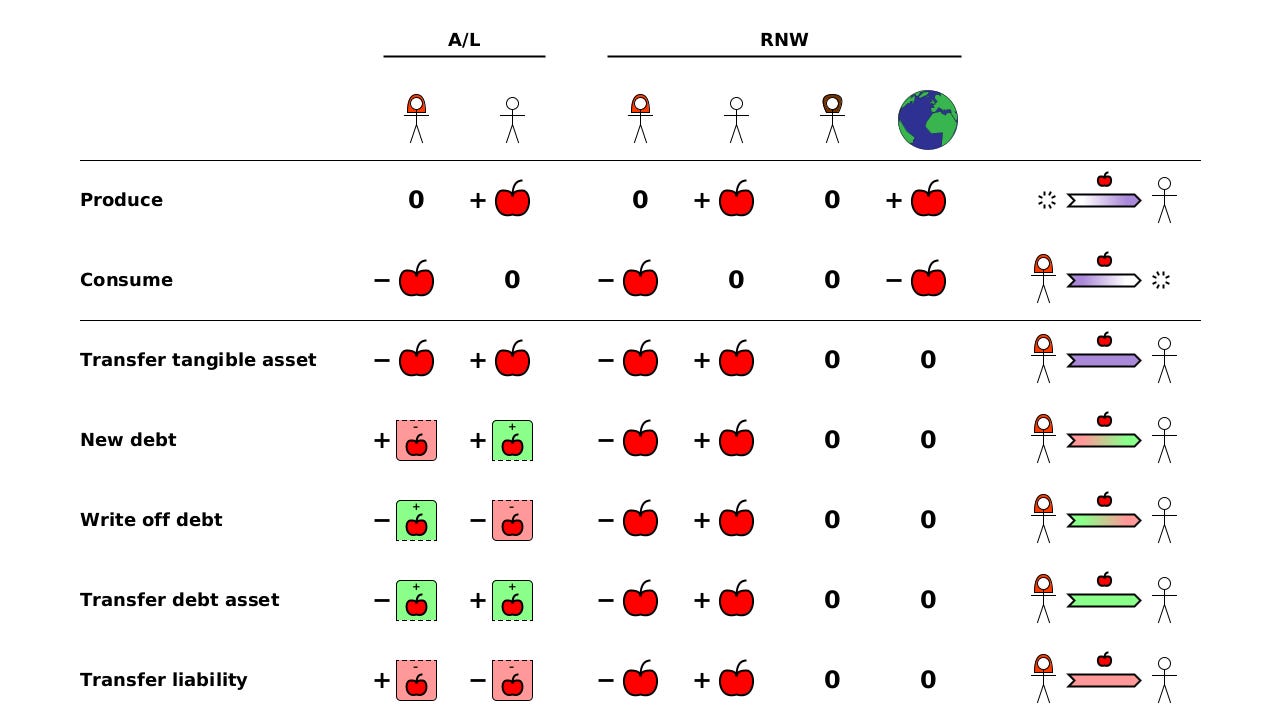
The only actions which leave you not owning something which you owned before4 are:
Transfer tangible asset, and
Consume
But it can’t be the first of these, because that would mean someone else gains the pristine anvil. And it can’t be the second because then you wouldn’t end up with any anvil at all. Does that mean we need a “partially consume” action after all? Let’s just go off on a tangent for a minute.
Getting from A to B on the Manchester Metrolink
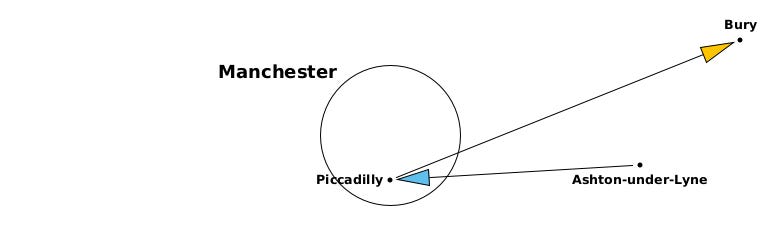
The city of Manchester in England has a light rail network (“Manchester Metrolink”). Suppose you’re in Ashton-under-Lyne, which is at the end of the light blue line, and you want to get to Bury, which is at the end of the yellow line. There’s no direct link from Ashton-under-Lyne to Bury, so what do you do?
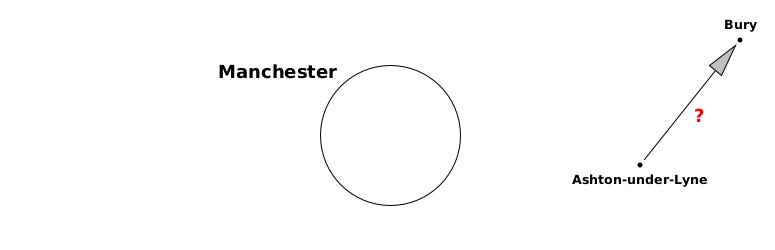
Even if you don’t know the area, you could guess that you can catch one tram from Ashton-under-Lyne into the centre of Manchester, and then catch another tram from Manchester to Bury. And you’d be right! The tram stop at the main railway station, Piccadilly, is on both the light blue line and the yellow line. So instead of going directly from A to B, you go from A to P and from P to B. You end up exactly where you would have if you’d been able to go from A to B directly.
Pristine anvil → chipped anvil
How does that help us with worn out anvils in Minecraft? Well, we’re trying to use actions to get from having a pristine anvil to having a chipped anvil, which we can’t do directly. But we can go from having a pristine anvil to not having an anvil at all (“Consume” action). And we can go from not having an anvil at all to having a chipped anvil (“Produce” action). Combine the two, and we’ve gone from having a pristine anvil to having a chipped anvil. Problem solved!
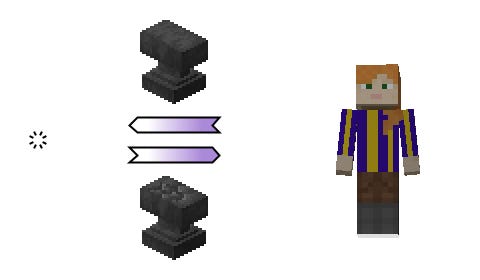
We don’t need a special “partially consume” action. It’s already covered by the existing 7 action types.
Other simultaneous production and consumption
Simultaneous production and consumption is very common: we’ve seen it many times before. For example, in the last article, we saw that to produce a furnace, you have to consume 8 cobblestone blocks in the process. In that case, we did it because we would rather have the furnace than the cobblestone. We’ve also seen it in this sequence of connected chains for producing a table in an article on supply chains.
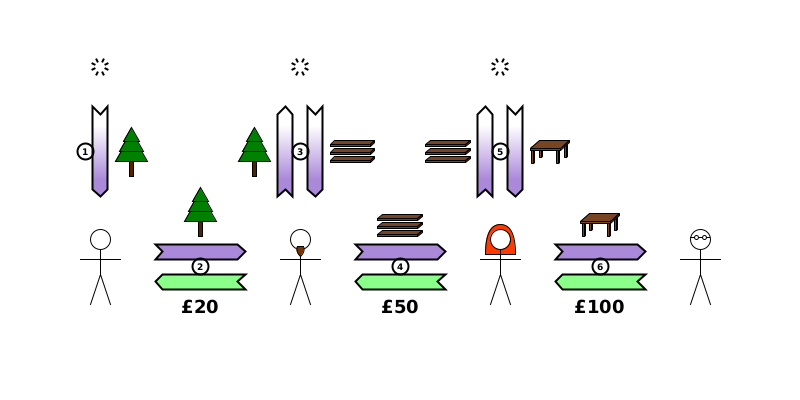
Wear and tear is a bit like this supply chain in reverse (but in this specific example without any change of ownership). You start from the product which you want, and it gradually deteriorates until you consider there’s nothing valuable left. Notice how the supply chain starts with a produce action by itself, and the diagram below ends with a consume action by itself.
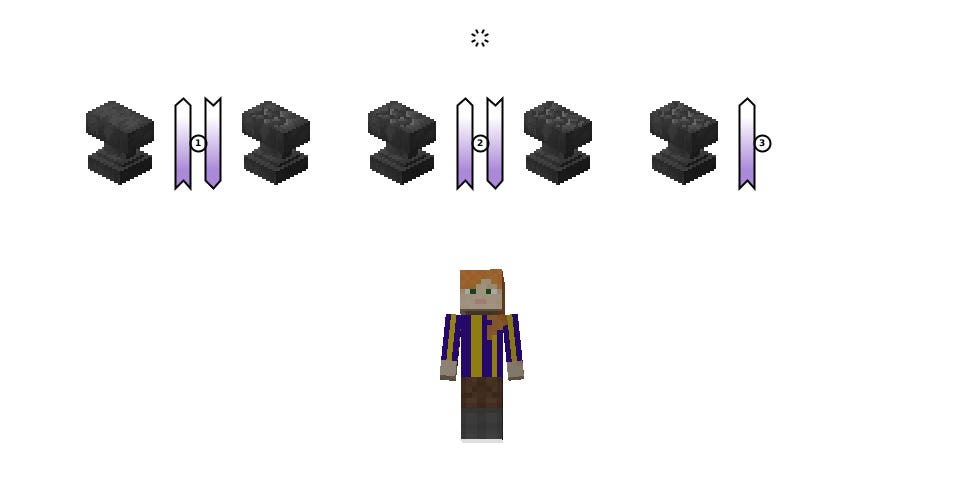
The only difference between pairs of consume/produce arrows in the two diagrams is that wear and tear consumes something you’d prefer to have, and produces something less desirable in the process. But do notice that this difference is subjective. Objectively, in both diagrams you’re just consuming one thing in the process of producing another thing. In fact, whether the consume/produce actions leave you with something more desirable or less can even depend on the circumstances. Breaking up a table into pieces of wood leaves you with something you’d normally consider less valuable, but if you’re in freezing conditions, and a table is your only source of fuel for a fire, you’d probably prefer to have the smaller pieces.
But breaking up a table for firewood is unusual. The normal process is that there’s a supply chain followed by a “consumption chain”5. We “add value” to raw materials to make “intermediate goods”, and then add value to those to produce a final product. The product serves us for a time, but this is temporary, and it gradually wears as it’s used or time passes, reducing its value to us until it’s discarded. Because of this constant wear and tear, we have to keep producing even to maintain what we have. Once we stop producing, the wealth which we’ve accumulated is going to continue to erode until eventually there’s nothing left.
Summary
Capital wears out as it’s used and as time passes. It generally loses value as it does so, in a mirror image of value being added at each stage of production in the supply chain from raw materials and intermediate goods to making the final product.
We don’t need a “partially consume” action to represent this, because we already have the actions to treat it as the simultaneous consumption of the less-worn product in the process of producing a more-worn product.
Next time we’ll look at entrepreneurship in Minecraft.
Thanks for reading!
Someone’s raw net worth (RNW) is what they own plus what they’re owed minus what they owe (i.e. their assets minus their liabilities). In general it is a “heterogeneous” sum/difference, which just means that things of different types are added and subtracted, not monetary “values” which have been assigned to them. If the idea is new to you, this article explains it with examples.
12% apparently.
Because you like Tolkien’s The Lord of the Rings, presumably.
Look for entries with “- apple” in the A/L column for Alice.
I have to give credit to Anthropic’s Claude LLM (or whatever it was trained on) for the observation that a sequence of deterioration like this can be represented as a group of individual chains spliced together.