

Most people would probably agree that food, fuel and housing are becoming much less affordable for most people. There’s been talk in the US recently about a single burrito costing $20, which is very expensive even by recent standards. But why is it happening? And can anything be done about it?
Understanding where prices come from — and how they change over time — is the topic of this new series of articles. Conventional economic theory says that supply and demand determine price, but that line of reasoning hides some assumptions which people rarely question. If you aren’t very careful, you can easily end up with wrong conclusions. Instead, we’re going to look at the subject in a fresh way.
We’ll start with a simple question: how is the price of a single product unit set in a market system1?
Notice that I wrote “product unit”, not just “product”. At times I’m going to distinguish between two things:
a type of product (e.g. Egremont Russet apple), and
a specific instance of a type of product (e.g. the Egrement Russet apple I bought at the local market last Tuesday).
Where it’s obvious from context, or it doesn’t matter, I’ll just write “product”, but when I need to be specific, I’ll write “product type” or “product unit”.
Invitation to treat, bid price, ask price, (agreed) price
If you see a label on (or near) a product in a shop, showing an amount of money associated with the product, it’s fine in everyday language to call that the price of one product unit, but it’s actually a bit more complicated.

If we want to understand economics, it’s important to recognise that there are several different things which you can think of as “prices”, and we mustn’t confuse them. Otherwise, we might make a wrong assumption about one of them which only works for one of the others. We’ll see more about this in later articles.
(For transparency’s sake, I’m not a lawyer, and this is not legal advice. It’s just my understanding based on what I’ve heard and read over the years, but I believe it’s essentially correct. I’d appreciate any corrections in the comments!)
A label is legally an “invitation to treat2”. It only indicates, to anyone browsing the products for sale, roughly how much money the seller wants for each product unit. It’s not binding on anyone.
If someone wants the product, and offers the seller a certain amount of money in exchange for it, the amount that they offer is a bid price. The seller can either accept or reject the proposal.
If the seller of the product tells a specific person that they will sell them the product for a certain amount of money, the amount that they ask for is an ask price. The potential buyer can either accept or reject the proposal.
If the seller and the potential buyer agree on how much money the product will be exchanged for, the sale happens, and that amount is simply the price of that product unit for that transaction.
Notice that number 4 is the price of that unit of that product for that transaction. It’s not the price of the other units. If Alice has 100 apples to sell, and Bob swaps 50p for one, then the price of that apple was 50p. The other 99 apples don’t have a price yet3. The price of an apple only exists at the instant that the agreement to buy/sell it is reached. It’s possible that 5 minutes later, Charlotte will agree to pay Alice 70p for another apple. Then Dom might convince Alice to sell him an apple for 45p.
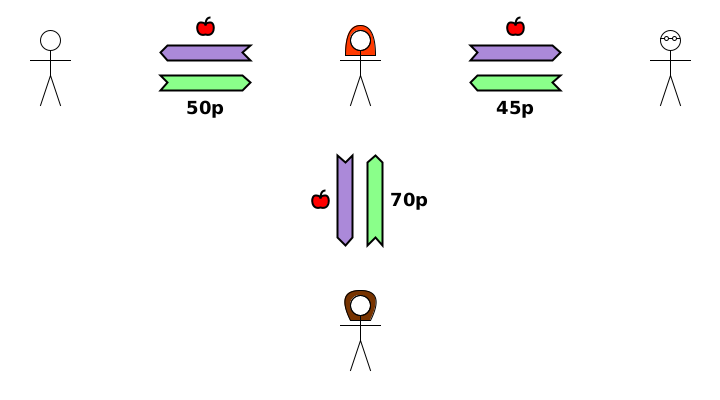
It’s also possible that, after Bob has bought an apple from Alice for 50p, Eve will buy it from him for 60p. So the price of the same apple was 50p in the first transaction, and 60p in the second.

It’s very common to think that all units of a product have, or should have, the same price, but that’s not how a market system works. The price is determined by what the potential buyer and the potential seller agree for a specific unit. So remember:
Price isn’t a property of a type of product!
It’s a property of a unit of a product,
and it exists only at the moment of the transaction.
Economists are often careless about this, and can end up convincing themselves of things which the average person can see are obviously not true.
That’s not to say that the prices of separate units of a product will vary wildly. They could, but we’ll see in a future article why we’d normally expect there to be some stability to the prices.
Price setting
What I’d most like you to remember is that there are two stages to setting a price in a market economy:
Negotiation (or “haggling”).
Agreement / transaction
Invitation to treat, bid price and ask price are all part of the negotiation. But the actual price is only set if and when the buyer and seller agree on a price and a transaction happens.
Supply and demand may influence the negotiation process, but ultimately the price is set to whatever the seller and buyer agree on. It doesn’t have to be rational or predictable.
RNW effects
To see how a sale affects everyone’s Raw Net Worth (i.e. what they own + what they’re owed - what they owe), let’s look at two cases:
Alice and Bob can’t agree on a price, and no sale takes place.
Alice sells Bob an apple for 50p.
No sale
If there’s no sale, there’s no change to what either Alice or Bob (or anyone else!) owns, is owed or owes. There’s absolutely no economic activity.

Nobody’s RNW changes.
Sale agreed
If Alice sells an apple to Bob for 50p, there are changes to what both Alice and Bob own, and are owed4. There’s no change to what anyone else owns, is owed or owes.

The purple arrow shows Alice’s RNW↓ one apple, and Bob’s RNW↑ one apple.
The green arrow shows Bob’s RNW↓ 50p, and Alice’s RNW↑ 50p.
So in total:
![[Alice] ΔRNW = - apple + 50p [Bob] ΔRNW = + apple - 50p](https://substackcdn.com/image/fetch/$s_!ezxe!,w_1456,c_limit,f_webp,q_auto:good,fl_progressive:steep/https%3A%2F%2Fsubstack-post-media.s3.amazonaws.com%2Fpublic%2Fimages%2F5c24cd75-e17d-47eb-aafc-f15dcdf334d6_512x128.png "[Alice] ΔRNW = - apple + 50p [Bob] ΔRNW = + apple - 50p")
Importantly, whatever price Alice and Bob agree on, there’s no change in Alice’s and Bob’s combined RNWs, and no change in anyone else’s RNW.
Prices in a planned economy
So far, we’ve been looking at a market economy. In a planned economy, people can usually still decide what to buy, but the price of each product unit sold may be decided by a central authority. For example, a government might decide that all apples must be sold at 23p each. In that case, Alice and Bob don’t go through the negotiation stage. Instead, Alice presents the apples which she wants to sell, and Bob can either decide to buy them or not. If he buys one, its price is 23p, and the sale occurs, exactly as if Alice and Bob had agreed on a price of 23p in a market economy.
The difference is all in the negotiation stage: how people reach the decision to buy or not buy. As far as the One Lesson is concerned, negotiation isn’t economic activity. Only the actions of the transaction are.
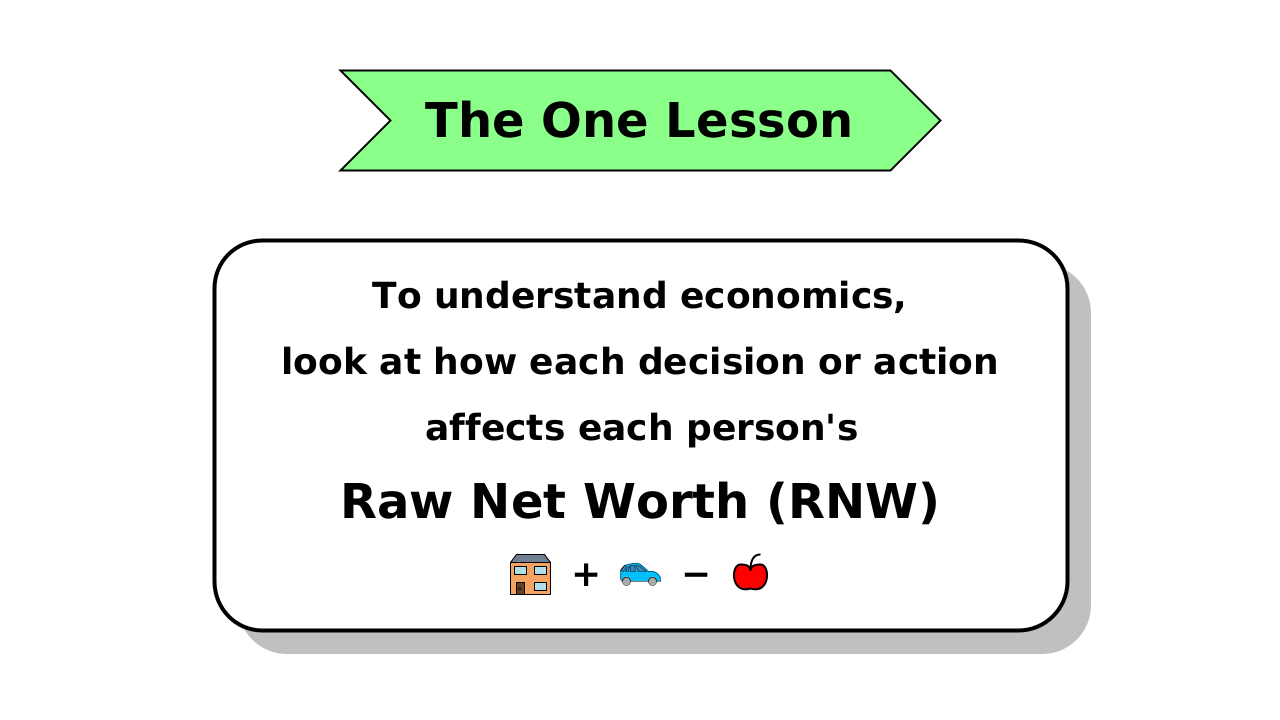
We’re not trying to predict how economic conditions affect people’s actions, but just show how people’s actions affect economic conditions.
Summary
In a market economy, the price for a product unit is negotiated between the seller and the potential buyer. If they can agree a price, the sale occurs, and the unit has that agreed price. (Other units are negotiated separately, and each can have its own price). If they can’t agree, the product unit has no price yet.
The difference in a planned economy is that the negotiation stage is replaced with a central authority’s decision. If someone decides to buy a product unit, the price has to be what the authority decided. But again, if nobody agrees to buy a product unit at that price, that product unit has no price yet.
But in either case, the price of a product unit isn’t what the buyer wants to pay, what the seller wants to receive, or what the central planner says it has to be. The price is the amount which is actually handed over in a particular transaction.
I’ll be describing my understanding of the approach which is traditional in England, and by extension the various places around the world which adopted the same approach. I don’t know that other traditions (e.g. France) work the same way. If you do know, please leave a comment below! Either way, I hope you find this interesting. And in any case, the rest of the articles in the series will still be relevant.
“Treat” in the sense of “negotiate”.
There could still be an invitation to treat, a bid price and/or an ask price
If Bob pays by credit card, there’s a change to what he owes instead of what he’s owed.