

Real world → theory → communication
Economics can seem quite overwhelming. There are so many objects of so many different types (houses, cars, bikes, loaves, apples, books, pencils, plates, knives, saws, chisels, lamps, multimeters, factories, roads, banknotes, cheques, credit cards, etc.) and so many events which happen (people making or breaking things, people swapping one thing for another, people taking away goods from shops after putting a small plastic rectangle next to a small box, etc.).
People have been trying for literally thousands of years to understand all this complexity. It’s no good just making a list of all these objects and events, because you’d have no understanding of the connections between one object an another, between one event and another, and between objects and events. Instead you have to look for patterns and ideas which can explain these connections.
Finding these patterns and ideas is the job of academics: people who have the time to think about it for hours on end. They can come up with a theory of how all the complexity and variety in the world can be explained by a small number of underlying ideas. Ideas like needs, desires, products, debts, trade, and so on.
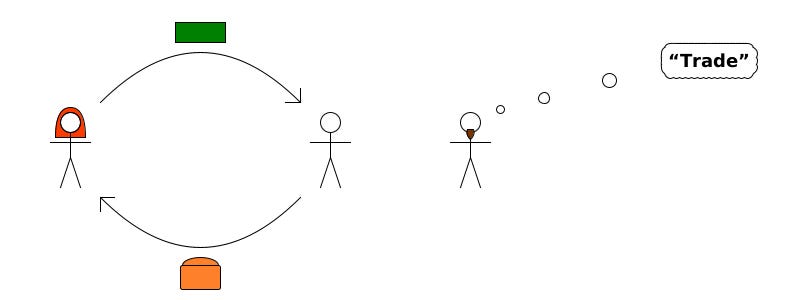
But even if their theory is right1, the ideas are often very abstract, and not always easy for non-experts to understand. If you talk to the average person about Gross Domestic Product, for example, their eyes will probably instantly glaze over. Maybe it’s bound to happen that some important ideas can’t be fully understood by the public, but it can be dangerous for these ideas to be completely controlled by a small group of people, especially when the effects of making bad (or corrupt) decisions can have a huge effect on everyone’s life.
So it’s important for specialists to communicate the ideas to the public in a way they can easily understand, and that’s what I’m trying to do with this blog. One of the most useful tools for communicating abstract ideas is the analogy. If you can find something which is based on similar ideas, but which people are already familiar with, the subject can become widely understood.
The analogy has to be good though. A bad analogy can mislead people, and perhaps encourage them to make bad decisions. An honest communicator must be very careful not to do this.
Card games as an analogy for the economy
I’ve recently thought of an analogy for the economy which I’m convinced is very helpful, honest, and familiar: card games. Here’s the basic idea.
A group of players sits around a table. In the middle of the table are a selection of coloured pens, and 3 decks of cards: one purple, one green, and one pink.
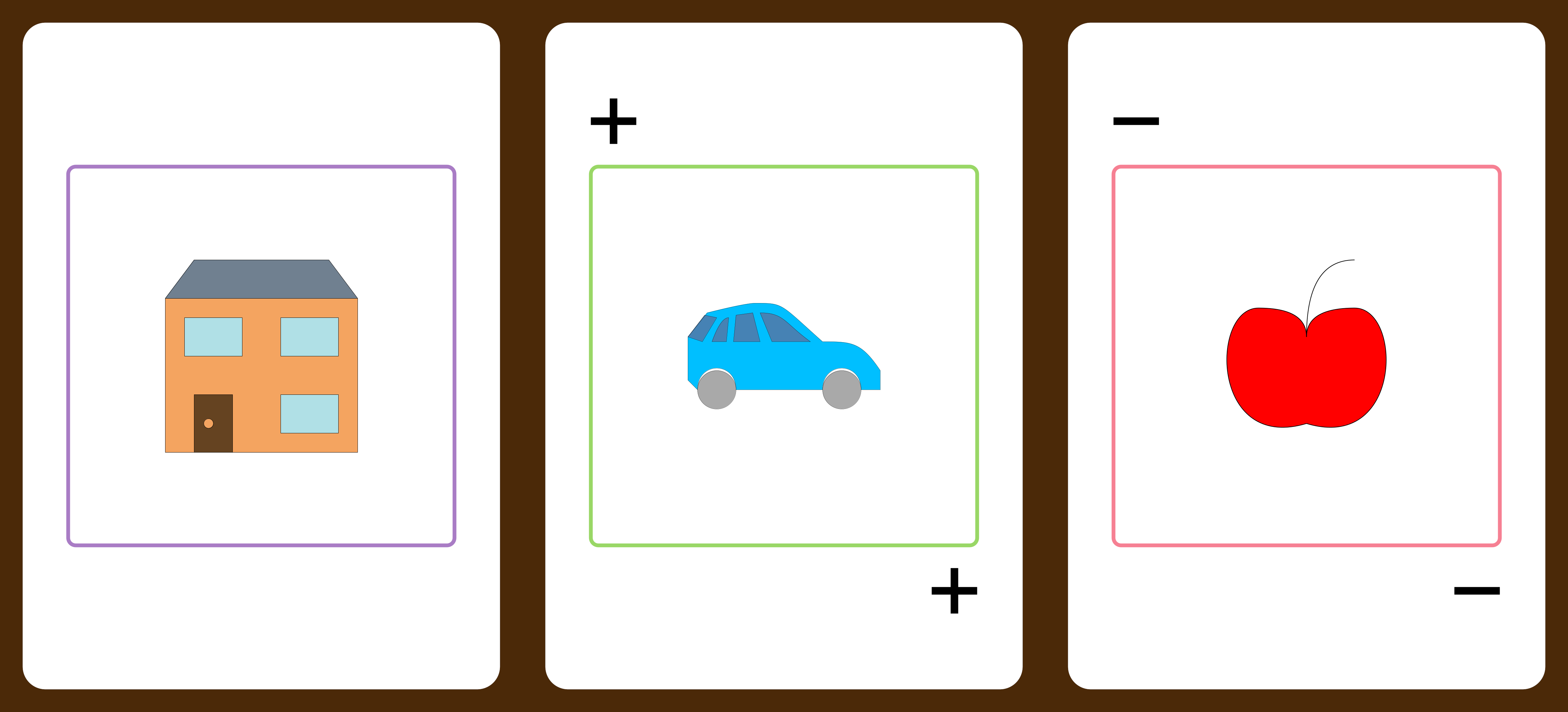
A purple card represents a product (what someone owns).
A green card represents a debt asset (what someone is owed).
A pink card represents a liability (what someone owes).
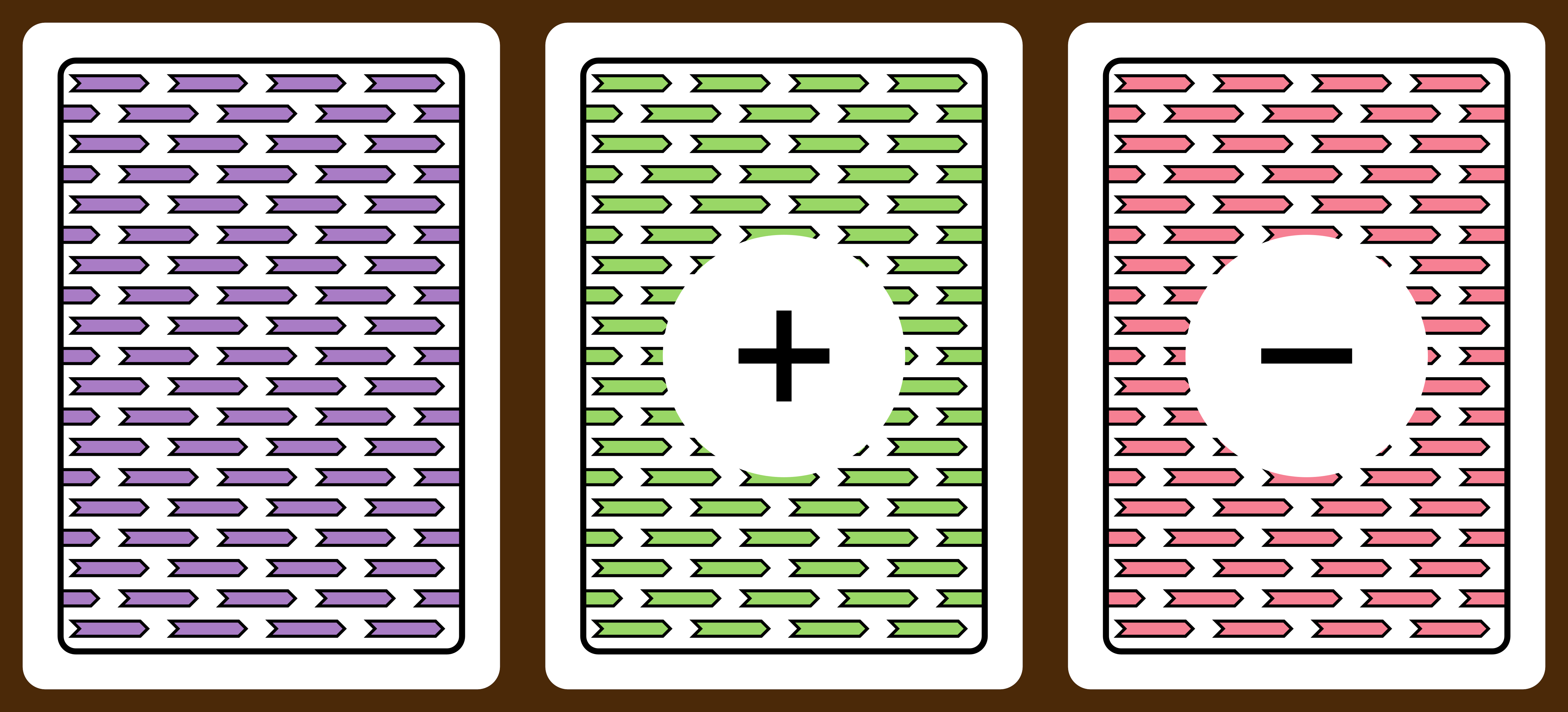
The front of each card shows what the player holding the card owns, is owed, or owes. Since there are so many different types of thing which people could own, be owed or owe, the fronts of the cards are blank at first, and players can use the pens to draw or write on them when they draw2 a card from one of the decks.
Players play by:
drawing cards from the decks,
transferring cards between players, or
discarding cards to a pile in the middle of the table.
Below I describe what these actions represent. And for each, I also show the corresponding arrow diagram which I’ve been using since I started this blog.
Purple deck
Production
Picking up a card from the purple deck represents producing a product3. The player uses the pens to draw on it what they just produced. They now own something which nobody owned before.

Transfer product
Transferring a purple card to another player (in any way) represents a transfer of ownership of the product to the player who now has the card. This can happen for any of several reasons:
The owner decides to.
The rules of the game force the owner to transfer it. Or,
Another player steals the card from the owner when they aren’t watching.

Consumption
Discarding a purple card represents consuming a product. What they previously owned is no longer owned by anyone.

Green and pink decks
New debt
Picking up a card from the green deck represents being owed something extra, which nobody owed before. This can only happen if another player picks up a card from the pink deck at the same time — and both players have to draw exactly the same picture on their cards. The player who picks up a pink card now owes something extra. Two players picking up the corresponding green and pink cards represents creating a new debt. The player with the new green card is the new creditor, and the player with the new pink card is the new debtor.

Transfer debt asset
Transferring a green card to another player represents transfer of a debt asset. The debt is still owed by the same player as before (the one with the corresponding pink card), but it is now owed to the new holder of the card instead of the previous holder. Just like with purple cards, green cards can be transferred voluntarily, by force, or through theft.

Transfer liability
Transferring a pink card to another player represents transfer of a liability. The debt is still owed to the same player as before (the one with the corresponding green card), but it is now owed by the new holder of the card instead of the previous holder. Normally the new debtor has to agree to accept the pink card, since it makes them worse off, but it’s possible that one player could sneak one of their own pink cards into another player’s hand.
Notice that the arrow below is in the opposite direction to the transfer of the card. This is because gaining a liability makes Alice worse off, and losing a liability make Bob better off.

Write off debt
Discarding a green card represents no longer being owed what’s shown on the card. This can only happen if another player discards a4 corresponding pink card, meaning they no longer owe the debt. Two players discarding corresponding green and pink cards represents writing off a debt.

Other rules
There isn’t enough information above to say how the game is played. You can imagine lots of different games which could be played with these 3 decks of cards, just like there are lots of games which can be played with a standard deck of 52 playing cards. But the rules above apply to all games.
There are other rules which always apply, because of how the world is. For example, there’s only a certain amount of gold in the world, so if people already have purple cards for all the gold which exists, it’s not possible for someone else to draw a card representing producing more gold5. And there are other physical constraints e.g. you can’t produce 1kg of charcoal, without consuming at least 2.5kg of wood.
Societies can also have laws and conventions which limit how players can play. For example, income taxes mean that employees have to give some of their green cards to a government player.
We’ll look at some specific games in future articles.
Summary
A card game using 3 decks of cards is a very helpful analogy: card games are easy to understand, and that understanding translates directly to understanding economics. If someone makes a claim about economics which seems dubious, always test it by imagining how the card game would look. (In my experience, they’re usually drawing a green and a pink card, but pretending that the pink card doesn’t exist).
Which may happen less often than you’d hope.
In card games, to “draw” a card means to pick it from the deck.
By “product”, I mean a good or a service.
It could be the exact same card which was picked up at the same time as the green one, but it could be one which is equivalent (“fungible”). I won’t go into the details here.
Unless there’s a meteorite strike.