

Last article, I said that a card game, involving 3 special decks of cards (purple, green and pink) is a good analogy for the economy.
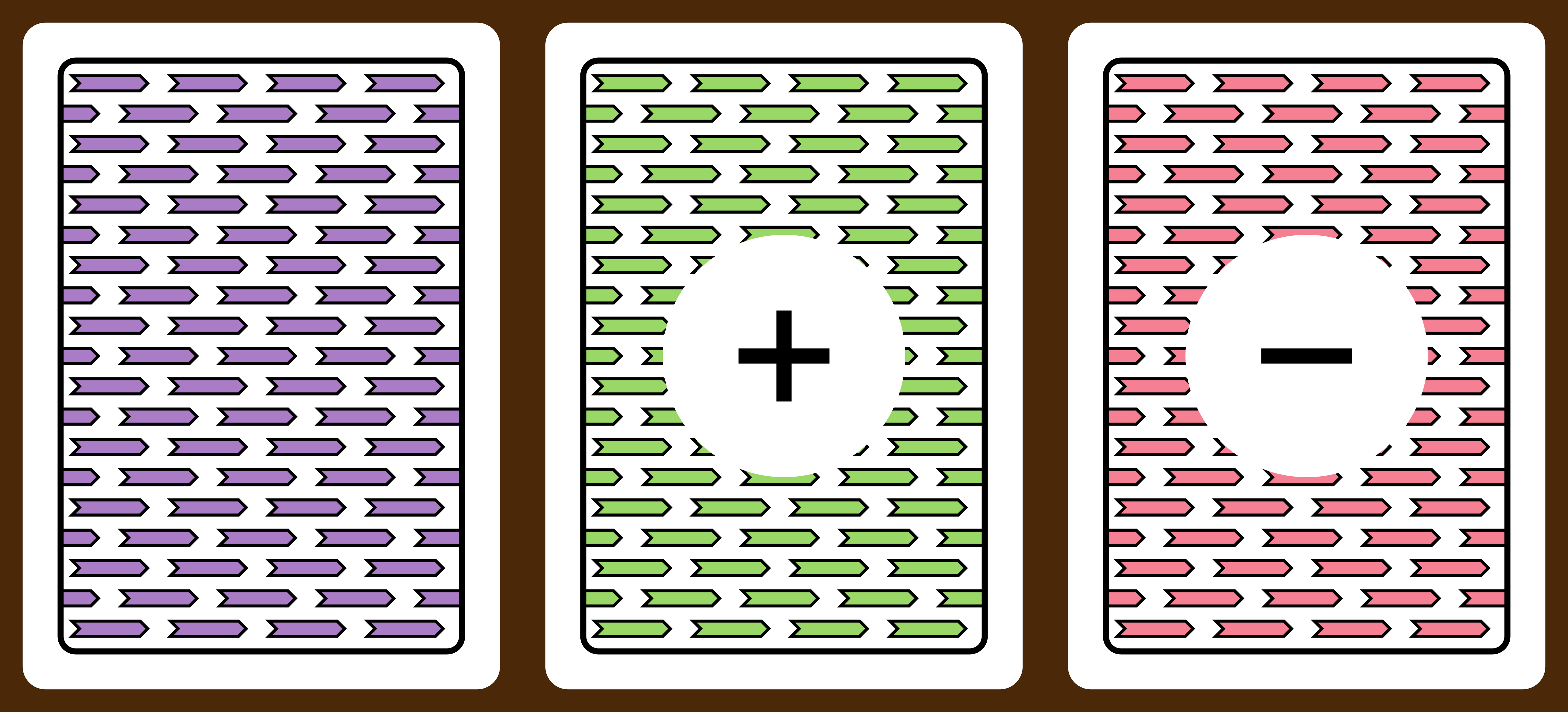
I want to be clear — this is a big claim I’m making here. People sometimes compare the real world to a game like Monopoly when trying to make a point about the economy. But games like that are artificial. Players do use money, buy and build houses and hotels, mortgage property, pay taxes, and so on, which are all things which happen in the real world economy. But most economic activity isn’t represented at all in the game, and some of what is represented is inaccurate (e.g. taxes going to the bank).
The card game is different. Every action in the economy which involves changes to what anyone owns, is owed or owes, is directly represented by players picking up, transferring, or discarding cards. It’s an accurate model of the economy.
There’s a very nice feature, which I didn’t mention in the last article. Each player’s hand (i.e. the cards they’re holding) represents their balance sheet:
The purple and green cards (what they own and what they’re owed) are their assets, and
The pink cards (what they owe) are their liabilities.
If they lay out the cards on the table, face up, with the purple and green cards on the left, and the pink cards on the right, that’s basically a standard representation of a balance sheet.
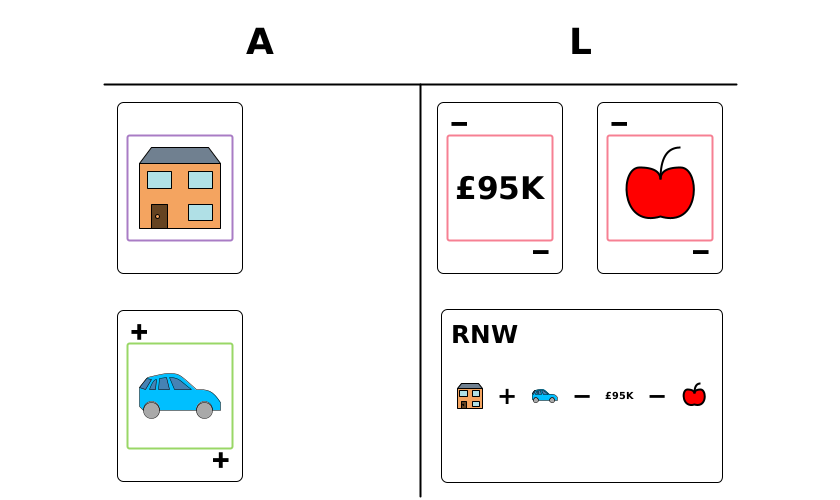
Let’s see a simple example, imagine Bob owns a house, and he’s already paid for a car but not had it delivered yet (so the retailer owes him the car). He still owes the bank £95,000 of his mortgage, and he’s promised to give Alice an apple. In the card game analogy, he’d have a purple card for the house, a green card for the car, a pink card for the £95,000, and another pink card for the apple.
![Balance sheet. [A] Purple card with a house; green card with a car. [L] Pink card with £95K; pink card with apple.](https://substackcdn.com/image/fetch/$s_!raWI!,f_auto,q_auto:good,fl_progressive:steep/https%3A%2F%2Fsubstack-post-media.s3.amazonaws.com%2Fpublic%2Fimages%2F53804cfd-003e-4009-807e-f997e1fd6203_420x300.png "Balance sheet. [A] Purple card with a house; green card with a car. [L] Pink card with £95K; pink card with apple.")
The only thing missing is a direct representation of (Raw) Net Worth1 on the right hand side to make the two sides balance. But that’s not a problem. The information is already there, because you can work it out by adding up all the assets, and taking away all the liabilities. If you wanted to show it directly, you could imagine doing the calculation, and writing it on a completely blank card which you put on the right underneath any of the pink cards.
The great thing about this card game analogy is that it’s accurate, it corresponds directly to what happens in the economy, and it’s easy to visualise. It means that you can use your existing understanding of card games to understand economics.
I’m convinced that a lot of misunderstandings in economics come from analogies which are relatively easy to picture, but aren’t accurate. But comparing the economy with the card game, your intuition will serve you well.
Summary
The card game described more fully in the last article is actually a model of the economy. It’s accurate and, being familiar and easy to understand, should make economics surprisingly intuitive. Next time your assets or liabilities change, try imagining what that would look like in the card game analogy, and let me know in the comments how you got on!
Someone’s raw net worth (RNW) is what they own plus what they’re owed minus what they owe (i.e. their assets minus their liabilities). In general it is a “heterogeneous” sum/difference, which just means that things of different types are added and subtracted, not monetary “values” which have been assigned to them. If the idea is new to you, this article explains it with examples.