

In this series, we’re looking at how Minecraft actually does a pretty good job of illustrating some important real-world ideas about economics, such as:
scarcity,
production,
consumption (both unproductive and reproductive), and
capital.
Minecraft doesn’t have debts, but it shows very clearly how the core of the real-world economy — production and consumption — works. When you produce something, you gain a tangible asset: you can see it appear in your inventory or in the landscape. When you consume something, you can see it disappear from your inventory or the landscape. It’s very easy to translate this into the arrow diagrams of the One Lesson, which show changes to what everyone owns, is owed and owes.
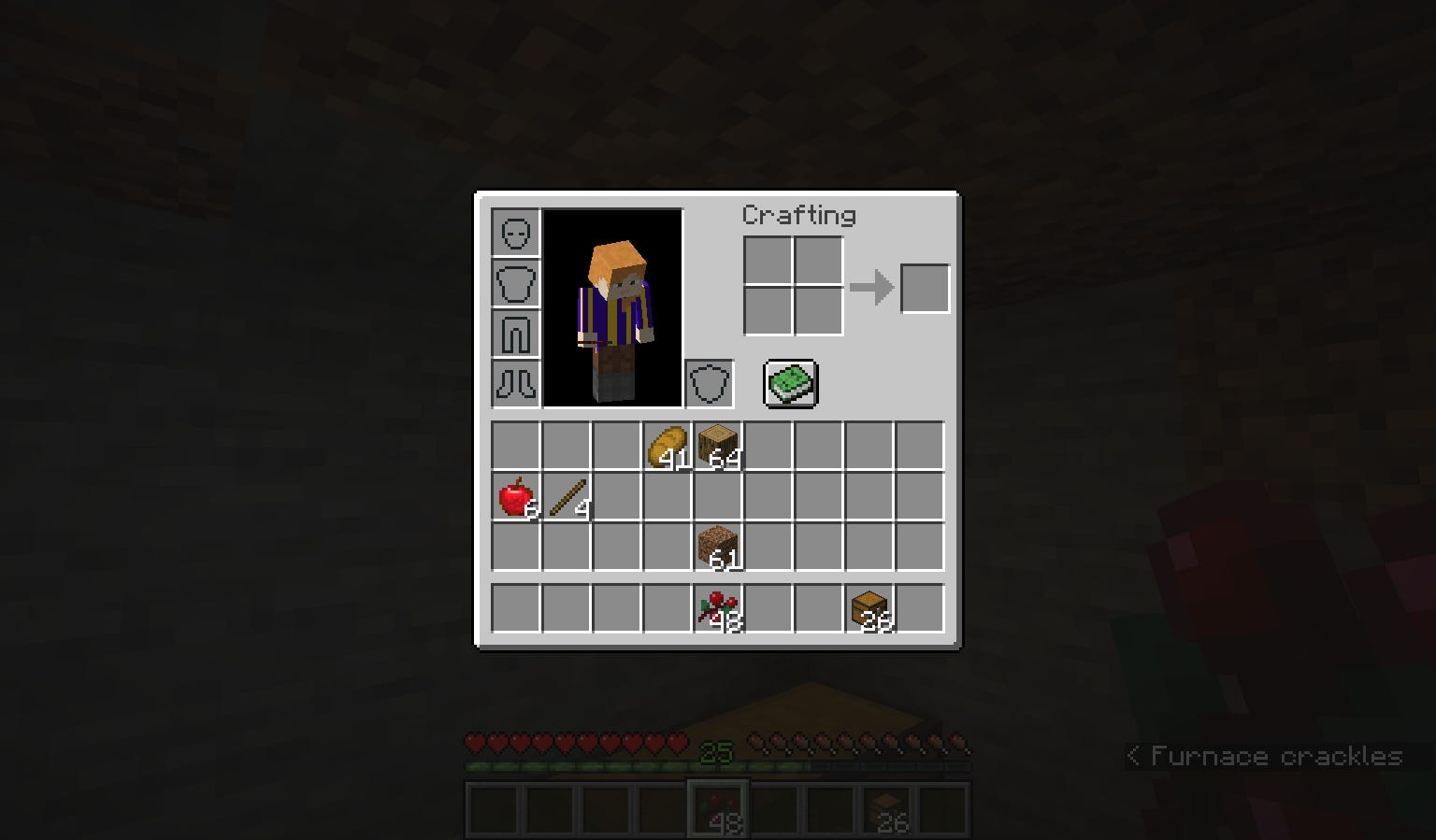
In earlier articles we saw that, just like in real life, you need to have and/or consume certain things to survive and thrive in Minecraft, and you combine a number of factors of production (land, labour, capital and entrepreneurship) to produce those things. In this article, we’ll look at becoming more sophisticated by using capital to make more advanced capital.
Unfortunately, with all the images, this article won’t fit in an email, so please follow the link (click on the title) to make sure you see all of it.
Technological eras — in history and in Minecraft
Most of human history can be divided into the following sequence:
Stone Age → Bronze Age → Iron Age,
where each describes the main material used for the most advanced tools at that time.
Each age provided some of the things needed to move on to the next age, but the advancement was far from automatic. Knowledge had to be acquired, materials had to be discovered, capital had to be produced, work had to be organised and actually done, and knowledge had to be passed down through the generations. And people also had to survive while all this was going on.
A similar sort of process happens in Minecraft. In the game, you can move through the following sequence:
Wood Age → Stone Age → Iron Age → Diamond Age1
Advancing from each age to the next in Minecraft involves basically the same steps:
Create a pickaxe using the current technology (and a crafting table).
Mine for the material (or its ores) needed for the next technology.
If it’s a metal ore, smelt it to produce the material (using a stone furnace).
Each technology is more durable than the previous one2. And each lets you produce other useful products which help you to survive and thrive. Let’s follow a player’s path through the technology sequence.
Wood Age
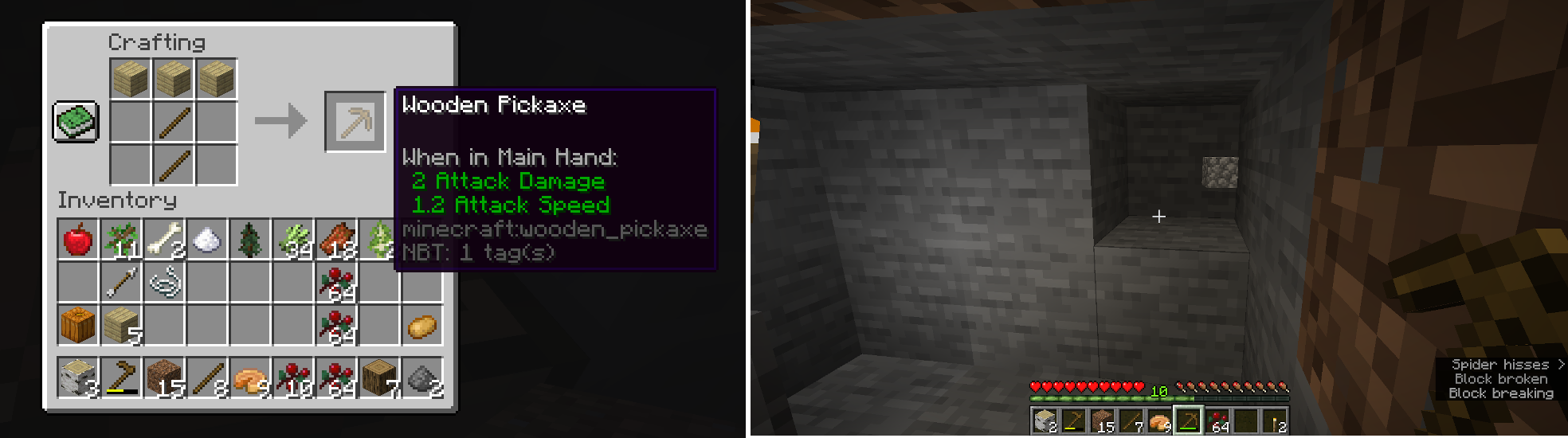
Once you have a crafting table, you can produce a wooden pickaxe using just sticks and planks — like the wooden hoe we saw in the last article. Then you hold the pickaxe, and hit a stone block until it breaks. It drops a cobblestone block item, which you can pick up. With just a few cobblestone blocks, you can move to the Stone Age.
Stone Age
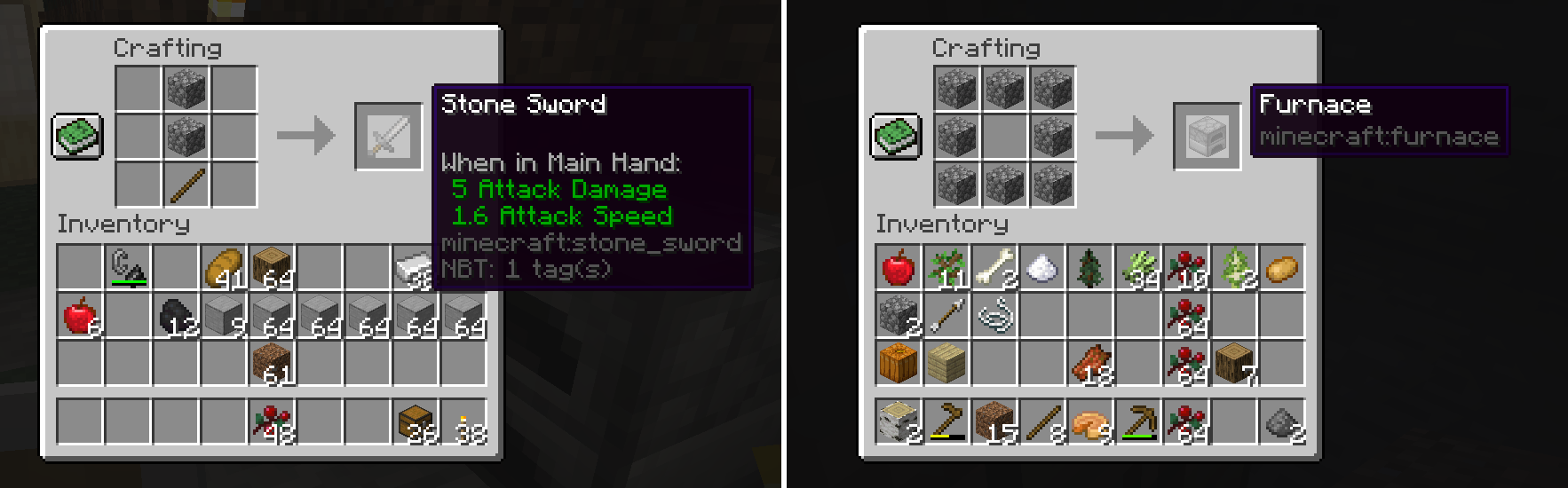
Now that you have cobblestone, you can make a stone sword, so you have a better chance to fight off a zombie or skeleton. And you can create a furnace, which has various uses, including to smelt iron ore, as we’ll see below.
The next step is to get iron. But if you try hitting iron ore with a wooden pickaxe, the block just breaks without leaving a floating item behind to pick up. You need to use a stone pickaxe. You’ll also need some fuel for the furnace to smelt the ore. Coal is fairly abundant, but again the wooden pickaxe isn’t good enough to mine it. So this is the time to make a stone pickaxe.
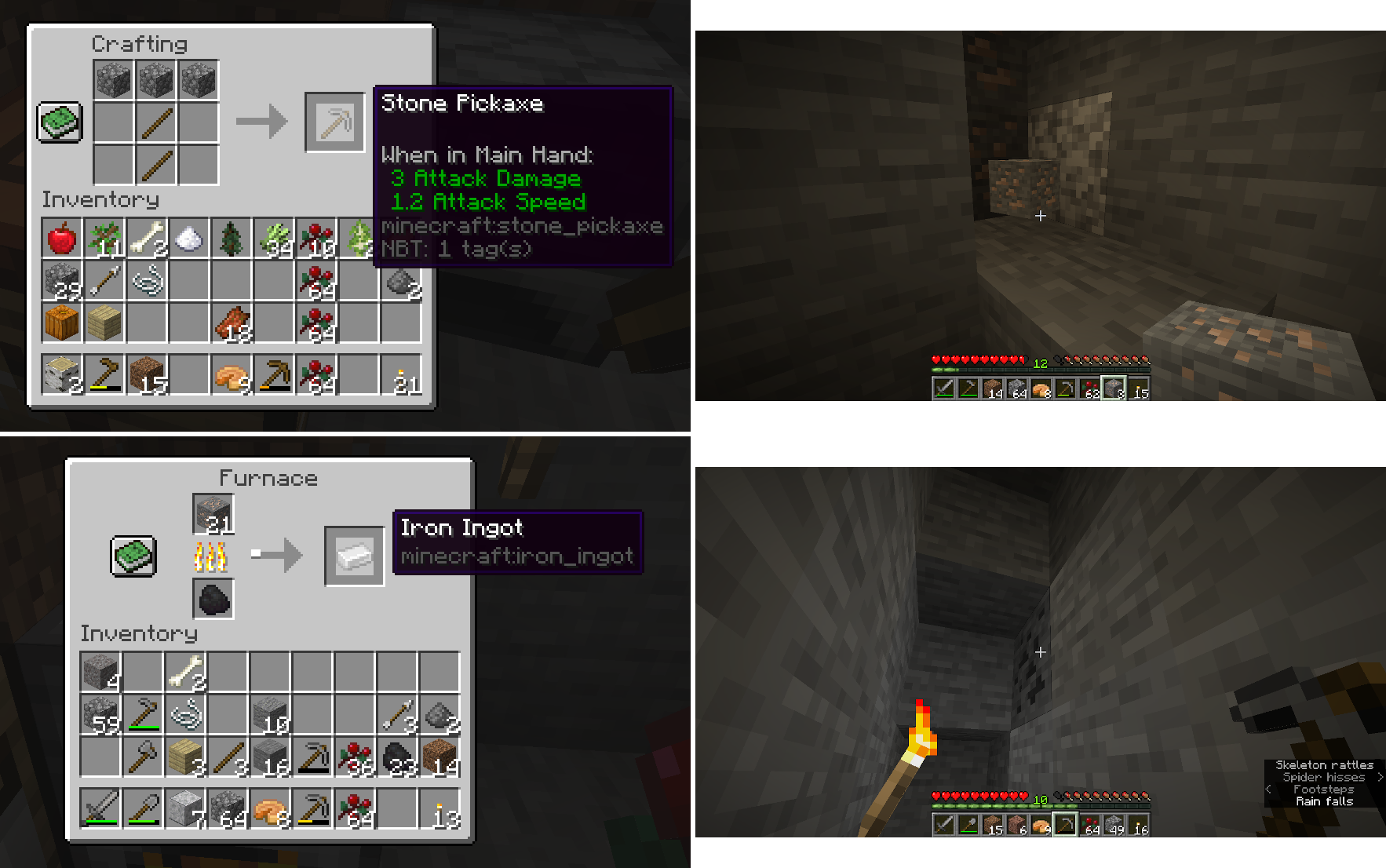
Once you’ve mined iron ore and coal, you can put them in the furnace you made, and iron ingots come out. You’re now in the Iron Age!
Iron Age
The Iron Age makes a huge difference to your ability to survive. You can make iron armour, which reduces the damage you take when you’re hit in combat, and a shield, which you can use to block arrows being shot at you by skeletons.
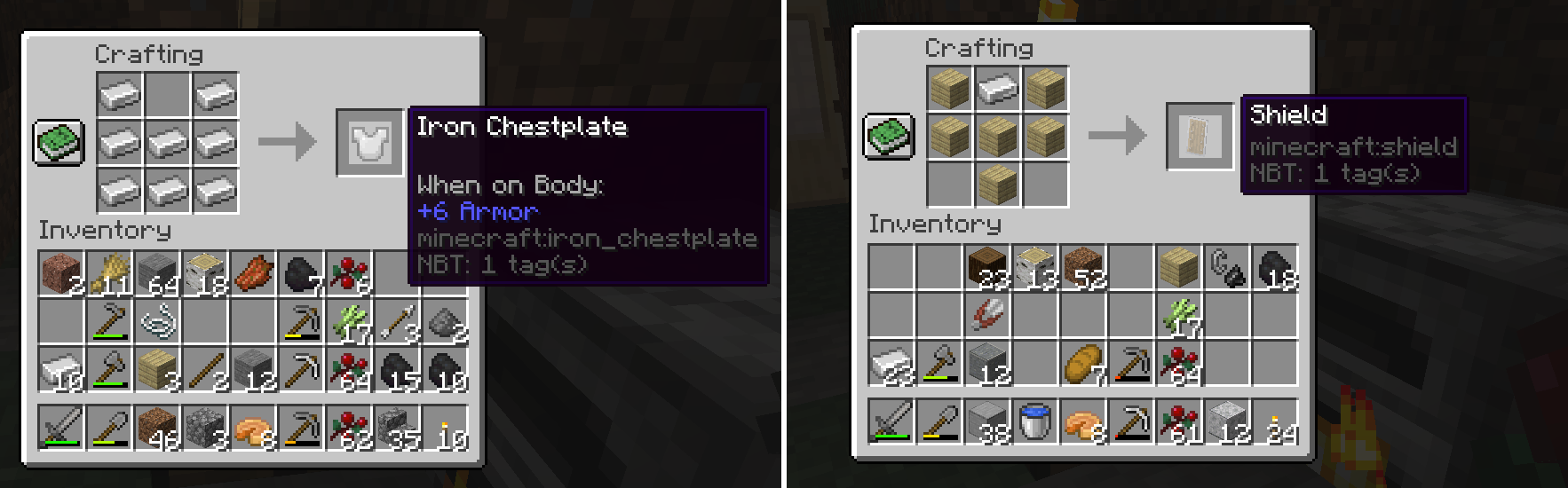
Just like you need a stone pickaxe to mine iron ore, you’ll need an iron pickaxe to mine diamonds from diamond ore. You can’t skip the Iron Age!
You have to mine deep underground to find diamonds.
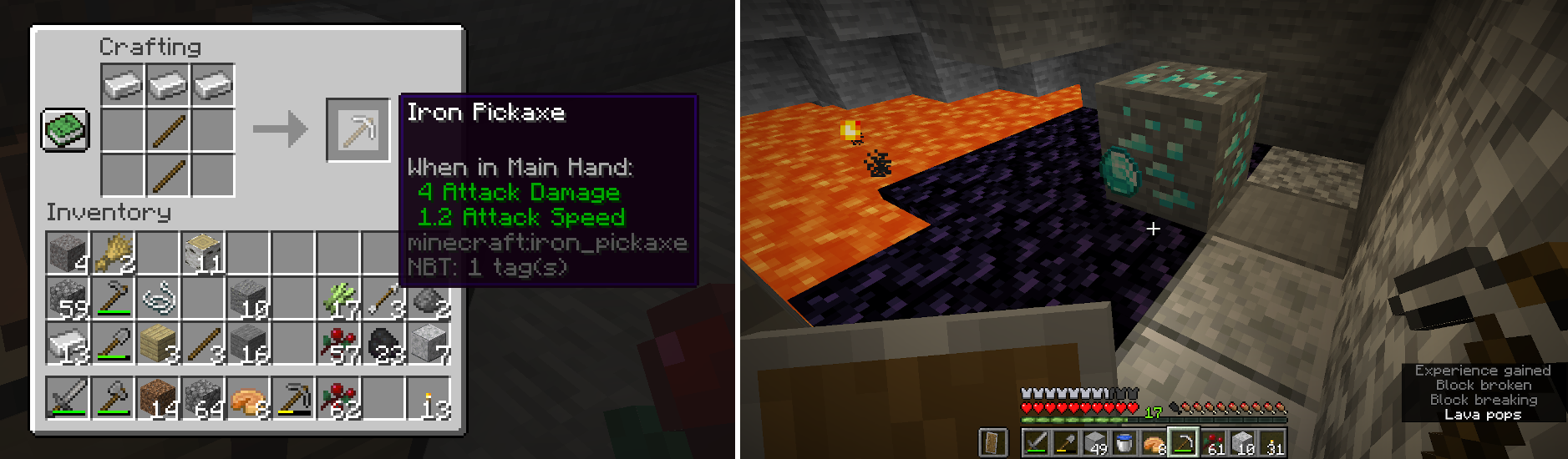
Diamond Age
With diamonds, you can make an even more durable set of tools.
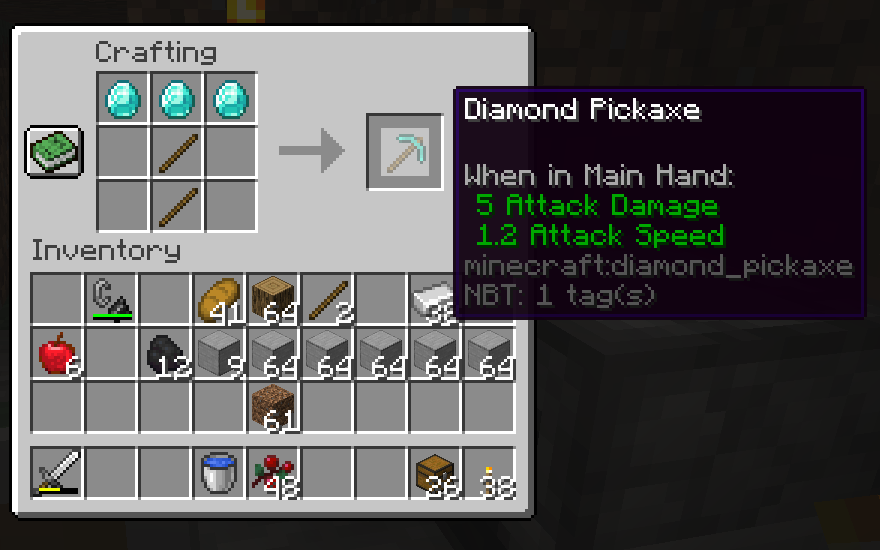
A diamond pickaxe will normally last comfortably long enough to find the 3 extra diamond ores which you’ll need to make a replacement pickaxe when the first one’s worn out.
And you can use any extra diamonds you mine in the meantime to make better armour, sword and tools. There are various other objects in the game which you can only produce if you have diamonds. But as this is an economics blog, and not a Minecraft blog, I won’t go into the details.
Arrow Diagrams — Stone Age to Iron Age
Let’s see the arrow diagrams for the economic activity involved in progressing from the Stone Age to the Iron Age. We’ll assume you already have a crafting table, and plenty of cobblestone and sticks.
Remember that the arrow diagrams only show economic actions: changes in what people own, are owed and owe. They don’t show:
the work involved in seeking out the raw materials,
the effort involved in working out how to create new products, or
the capital needed in the production process — unless it is actually consumed.
Do compare the diagrams to the images above to make sure you agree with them.
Produce furnace

You consume 8 cobblestone blocks in the process of producing a furnace. (You need to have a crafting table, but it isn’t consumed). Since the cobblestone is a necessary raw material for creating a furnace, this is reproductive consumption.
Produce stone pickaxe
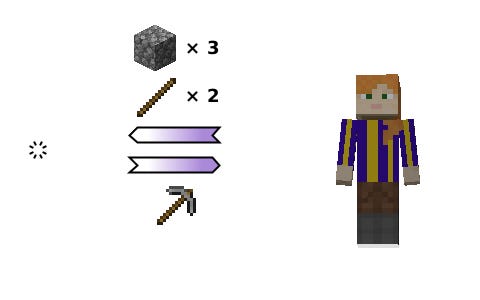
Producing a stone pickaxe requires reproductive consumption of 3 cobblestone blocks and 2 sticks. (You also need to have a crafting table).
Mine iron ore

Mining iron ore is just production, like harvesting wheat. You end up owning iron ore which you didn’t have before, and don’t lose anything.
Mine coal

Mining coal is also just production.
Smelt iron ore
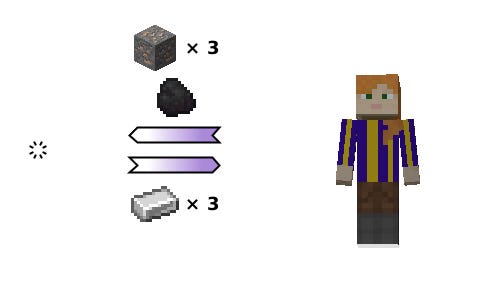
Smelting iron ore requires a furnace, but it isn’t consumed at all. The iron ore and coal are reproductively consumed in the process of producing the iron ingots.
Produce iron pickaxe
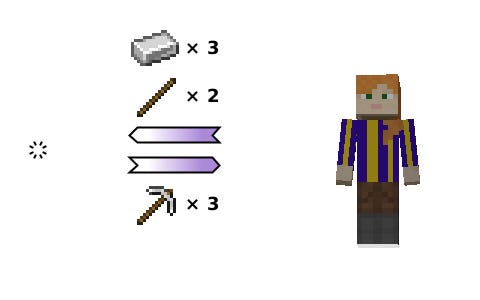
Producing an iron pickaxe requires reproductive consumption of 3 iron ingots and 2 sticks. (And you need a crafting table).
Complete sequence — Stone Age to Iron Age
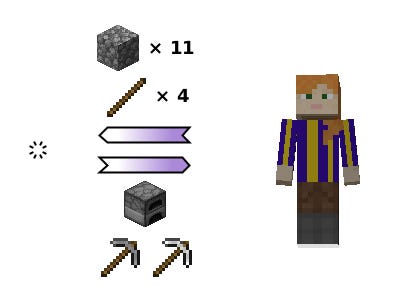
We can see from the diagram that you end up with 11 fewer cobblestone blocks, and 4 fewer sticks, but gain a furnace, a stone pickaxe and an iron pickaxe.
In fact, you’ll almost certainly end up with lots of other blocks because you’ll normally have to mine through them while you’re searching for the coal and iron ore you need. Also, your stone pickaxe will be wearing out as you mine with it. You may even have to produce several of them before you find enough iron ore and coal to produce an iron pickaxe.
In the next article, we’ll look at how we can represent capital wearing out like this. Once again, Minecraft is surprisingly good at illustrating this idea, even if it’s a bit simplified compared to the real world.
Summary
In real life, developing more sophisticated capital which makes us more productive involves lots of different steps, and often lots of people. Minecraft is only a game, and it’s simpler than real life, but the basic idea is there. Technology progresses through generations (stone, iron, diamond), each one building on the advancements of the previous one.
The result is not only productivity which is orders of magnitude higher than is possible without the development of more and more advanced capital, but the ability to create products which would be impossible no matter how long you worked on it. As a real-world example, it’s simply impossible for a Stone Age civilisation to create a telephone which allows people to speak to other people almost anywhere in the world with no delay.
Thanks for reading!
Since version 1.16 of Minecraft, there’s an additional material called netherite, which is even more advanced, but it doesn’t add anything to our understanding, so I won’t mention it further.
Wooden tools break very quickly, but diamond tools last a long time.