

As we’ve seen in this series, Minecraft illustrates the most fundamental part of economics — production and consumption — very well. These articles have concentrated on the “factors of production” i.e. what you need in order to produce things:
Land — the world’s resources in their natural state,
Labour — manipulating the world around us with our bodies,
Capital — using what we’ve already produced in order to produce other things more efficiently, and
Entrepreneurship — obtaining, bringing together and organising other factors of production to dedicate them to producing something.
Land is obviously a crucial part of production in Minecraft (e.g. it’s the source of food, raw materials and fuel), so we’ve mostly looked at labour and capital up to this point. But what about entrepreneurship?
What’s an entrepreneur?
When you imagine an entrepreneur, you might be thinking of someone who employs people to work on producing something. That would mean that entrepreneurship isn’t part of Minecraft because there aren’t any other people to employ for their labour1.
But entrepreneurship is more general than this. The most important aspects of entrepreneurship are:
Deciding what to produce,
Deciding how to produce it, and
Investing to obtain and gather all the resources needed to actually do the production.
In economics, investing doesn’t mean buying a financial product (e.g. bonds or shares) in the hope of getting back more money than you spent on it. What it usually means is trading something (typically money) for factors of production, such as wages for labour, rent for land, and interest for borrowed capital2, so that you can use them to produce a product which you hope to sell for more than you spent. But providing the factors yourself is a perfectly good alternative, so you can be an entrepreneur in Minecraft.
Whether you buy factors or produce them yourself, the difference between the output of the production process (i.e. the things produced) and what you invested is your profit. That’s generally the main incentive for entrepreneurs to put in the effort and/or expense of the entrepreneurship.
In this article, we’ll look at what you, as an entrepreneur, need to do to set up an automated pumpkin farm in Minecraft. It’s a sort of factory in which pumpkins grow, and are automatically harvested and stored in a chest for you to collect at your convenience. You have to put in a lot of effort and/or expense to start with, but once it’s set up, then as long as you can also get sugar and eggs3, you essentially have unlimited food (pumpkin pies) with almost no effort. You’re reaping the reward of your earlier investment. This leaves you free to work on other things, like mining for diamonds.
Here’s what a basic pumpkin farm looks like:
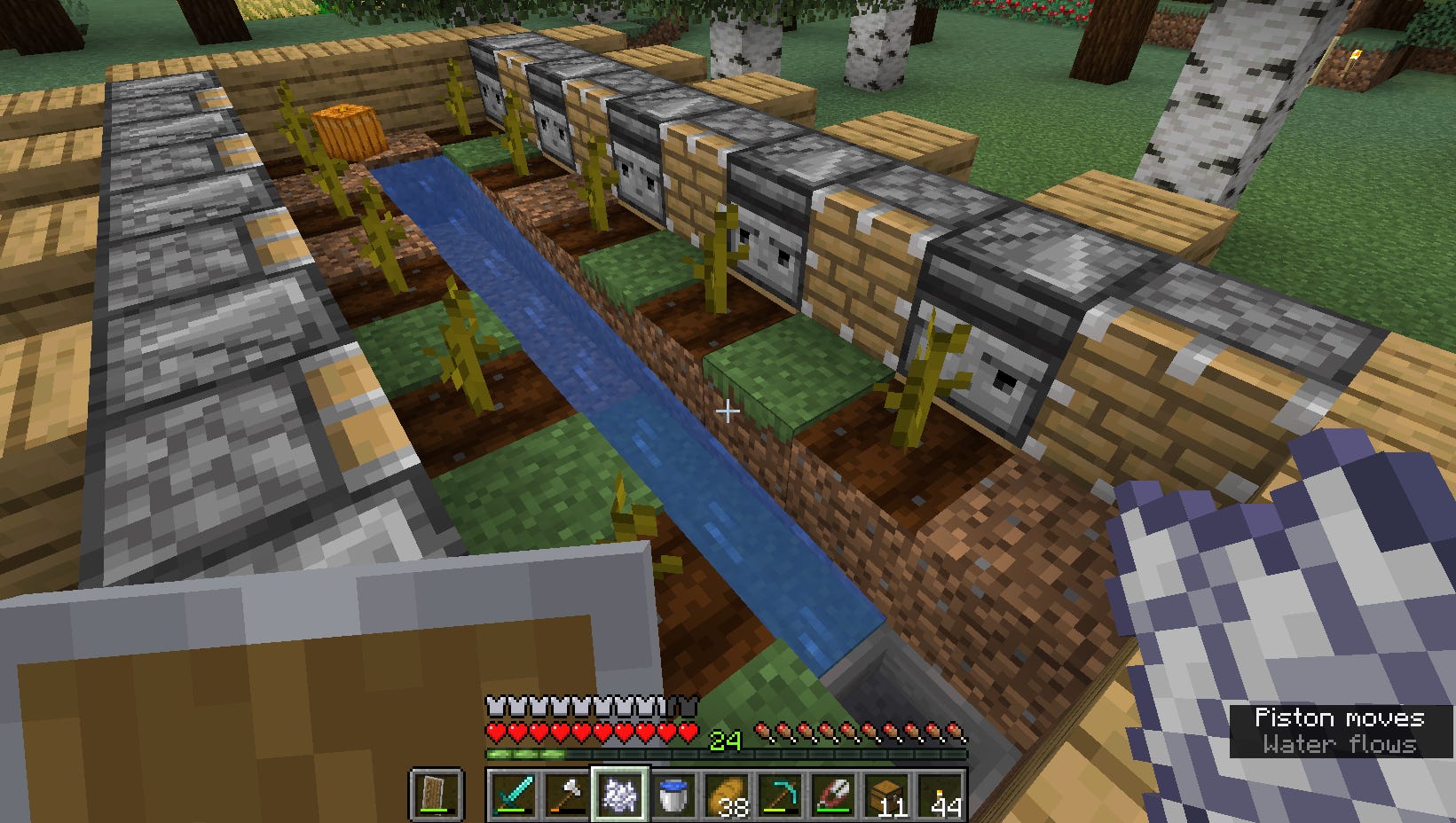
Let’s see how it works, and what setting it up involves.
Redstone and automation
To understand how production can be automated in Minecraft, you need to know a bit about redstone. It’s basically Minecraft’s equivalent of electricity, and it’s astonishing what can be done with it. Here’s a very basic introduction:
You can find redstone ore deep underground. If you hit the ore block with a pickaxe, you get some redstone dust.
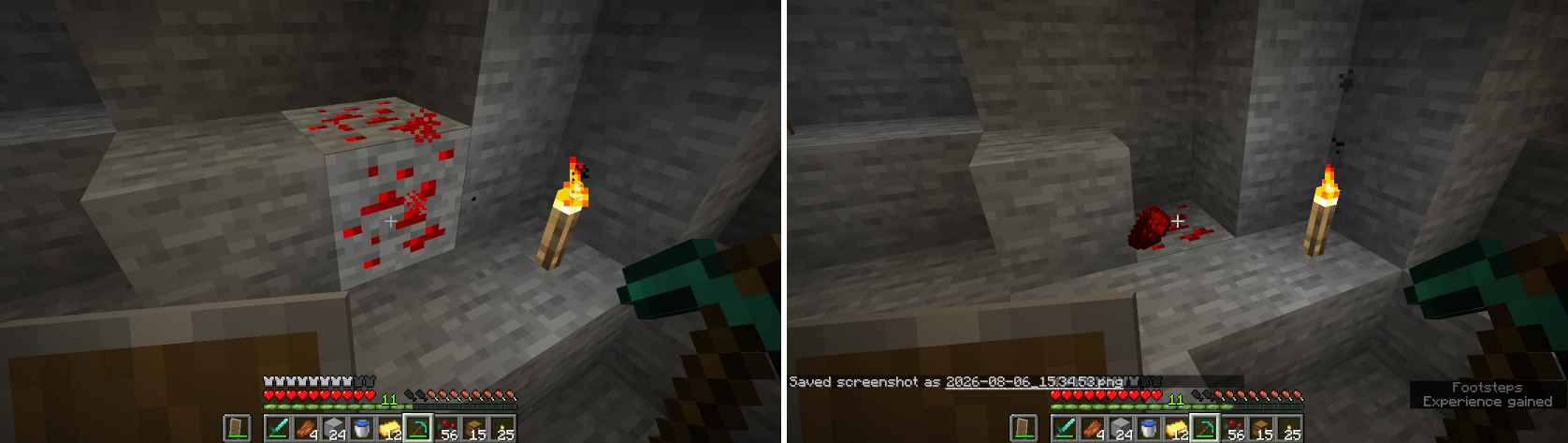
This can be used as a raw material in producing various redstone components (similar to electronic components), or it can be placed on the ground to make a channel for a current of redstone power to travel along. Redstone power can either come from a constant source (such as a redstone torch4), or from some sort of detector (such as a button, a pressure plate, or a light detector). Redstone power can be used to activate other redstone components, e.g. extending a piston, lighting a lamp, or opening a door.
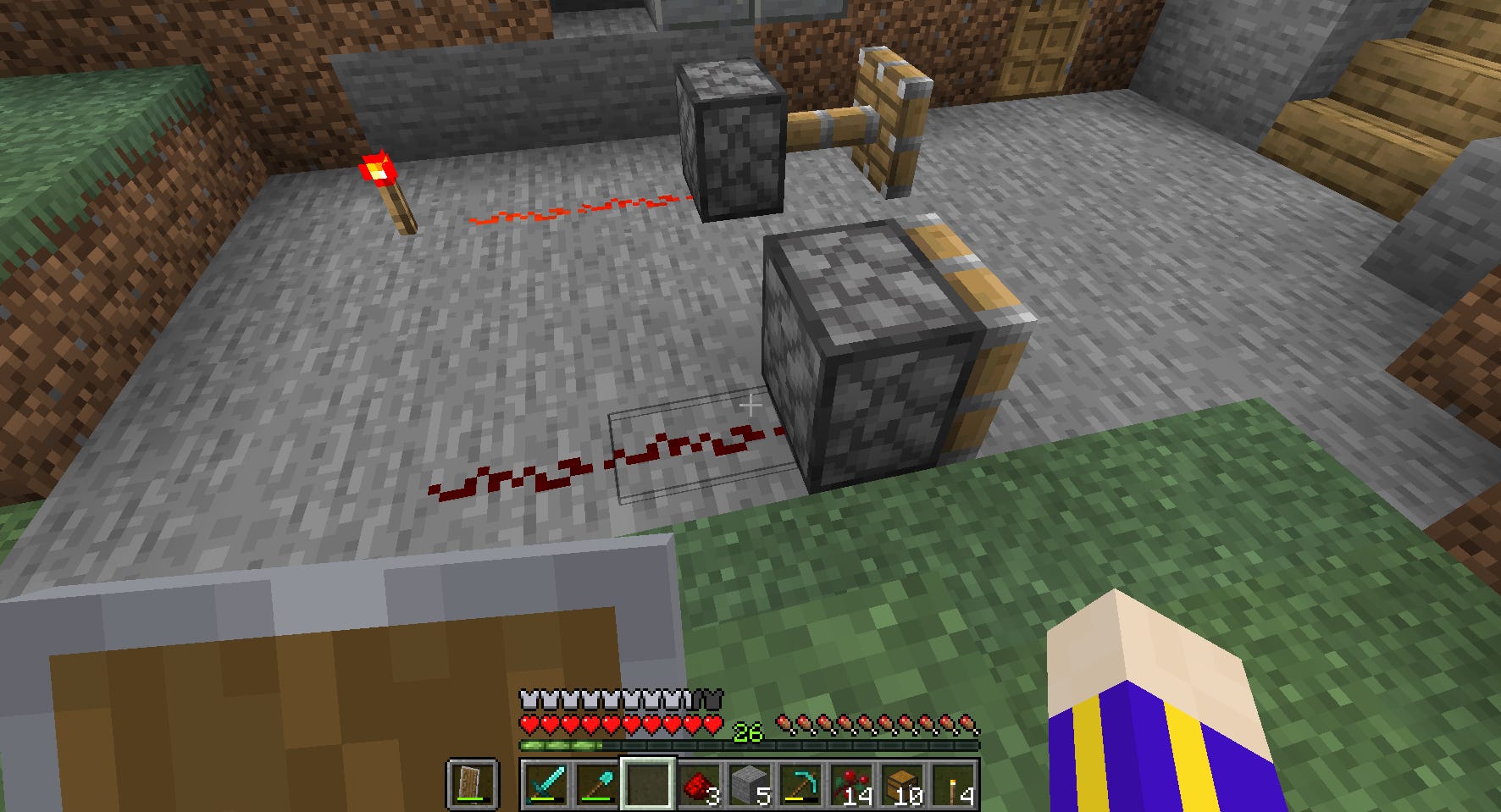
Pumpkin farm
The basic components of a pumpkin farm are:
Tilled soil, for the pumpkin plants to grow in,
Pumpkin plants themselves,
“Observers” — redstone components which generate a pulse of redstone power when they detect that something in front of them has changed (in this case, when a pumpkin plant has grown a pumpkin),
Pistons, which break the newly-grown pumpkin, leaving a pumpkin item, when triggered,
Redstone dust, for getting the pulse of redstone power from the observers to the pistons to make them extend briefly,
A channel of flowing water, to carry the harvested pumpkin item towards a chest where it can be stored,
A chest, to store the harvested pumpkins in,
A hopper, which can collect the pumpkins and put them into the chest.
Various other blocks to place redstone dust on, create a channel for the water to flow along, etc.
To make or collect most of these, you need various ingredients, which you can’t just find lying around. Let’s consider just one of the ingredients you need: nether quartz, which you need to make an observer.
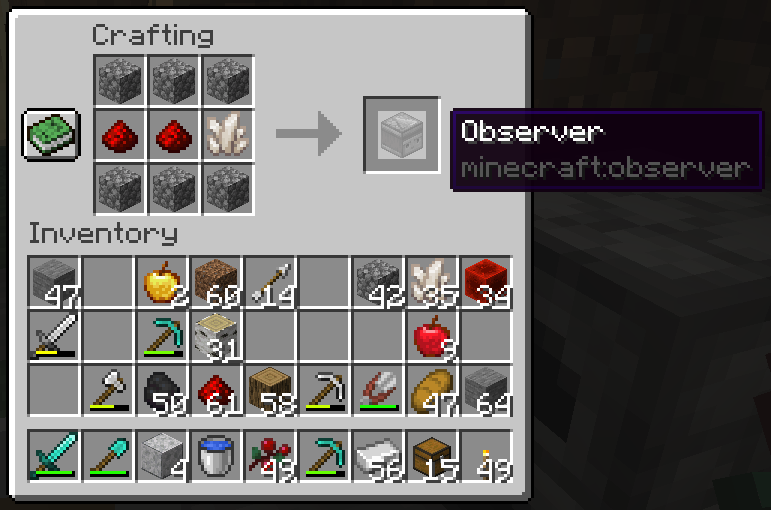
You can only find nether quartz in the nether, which is a hellish parallel world full of lava and quite a lot of hostile mobs. To get there, you need to make a nether portal out of obsidian.
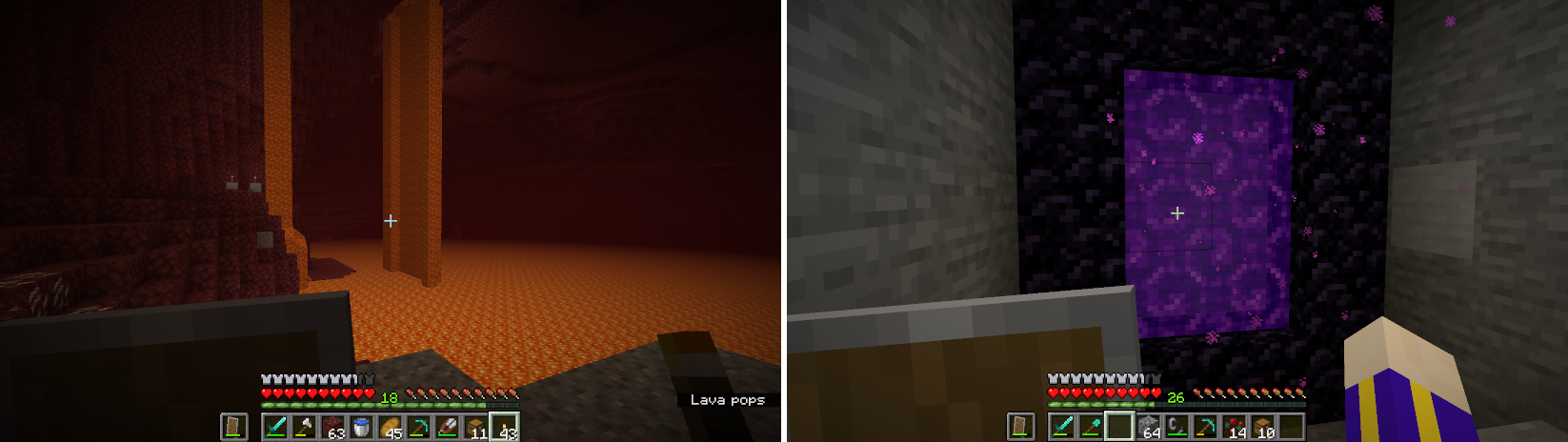
And to mine obsidian you need a diamond pickaxe. You probably want diamond armour5 to survive in the nether too. So to get just one of the ingredients for the pumpkin farm, you need to advance all the way through the wood age, stone age, iron age and some way into the diamond age, as we saw in an earlier article. This is what entrepreneurship is all about: putting in lots of effort first in order to profit from it later.
To be fair, chances are that by the time you’ve reached the point where you can mine nether quartz, you’ll have acquired most of the other ingredients you need for the pumpkin farm. But even so, I hope you can see that the work involved in building the pumpkin farm is a major undertaking6. It’s up to an entrepreneur to decide whether the potential for profit is worth the upfront cost, and to check that they can actually afford to make this investment before the payback starts.
Ongoing costs in the real world
As I’ve warned before in this series, even though Minecraft illustrates some ideas from economics extremely well, you have to remember that it’s not exactly the same as real life.
The pumpkin farm in Minecraft will operate forever, constantly producing new pumpkins at no cost whatsoever. But in the real world, capital wears out over time. That means that some of the entrepreneur’s profit has to be spent on maintaining the capital, and they have to take this cost into account when they decide whether it’s worth going ahead with the project.
And there are several other costs which they have to consider:
Rent (for use of land)
Wages (for employees)
Buying inputs (the raw materials and intermediate goods which go into making the product)
Interest (for any money borrowed)
Taxes
These all decrease the profit left over for the entrepreneur. If costs increase, it’s that much less worthwhile for the entrepreneur to undertake the production, and it can even make the profit drop to zero or less. The only source of “raw” income in total is the difference between what is produced and what was consumed in the process. In order to have any income at all, the entrepreneur has to organise and fund a production process in which all the costs come to less than the total raw income, which can’t even be known in advance, so it’s always a risk.
![[1] (TD) Bob→Alice/Charlotte/Dom {Costs}. (S) Alice/Charlotte/Dom→Bob {Factors} [2] (C) Bob→void {Raw materials}. (P) void→Bob {Products} [3] (TT) Bob→world {Products}. (TD) world→Bob {Revenue} [4] (TD) Bob→gov {Tax}](https://substackcdn.com/image/fetch/$s_!LA6v!,f_auto,q_auto:good,fl_progressive:steep/https%3A%2F%2Fsubstack-post-media.s3.amazonaws.com%2Fpublic%2Fimages%2F83a25ac4-4822-41d8-b65d-379c28b9798d_720x640.png "[1] (TD) Bob→Alice/Charlotte/Dom {Costs}. (S) Alice/Charlotte/Dom→Bob {Factors} [2] (C) Bob→void {Raw materials}. (P) void→Bob {Products} [3] (TT) Bob→world {Products}. (TD) world→Bob {Revenue} [4] (TD) Bob→gov {Tax}")
Summary
Entrepreneurship is deciding to produce a product (usually something which isn’t easy to make), devising a process to produce it, and then obtaining all the necessary resources in advance (usually by buying them) with absolutely no guarantee of success. If it’s successful, then it can be very profitable, but it can very easily lead to losses for the entrepreneur, even if other people (employees, suppliers, lenders, etc.) benefit from it.
The pumpkin farm in Minecraft demonstrates some important aspects of entrepreneurship: especially the large up-front effort needed to set up a complex production process, and the profit which is the reward for that effort.
Thanks for reading!
100 articles!
This is my 100th published article. I seem to have averaged about 30 articles per year, which is a bit less than I’d hoped, but at least it seems like more output than I produced when I was a mathematics and computation undergraduate many years ago.
Thanks to everyone who’s been following along, and everyone who’s joined in over the last 3 years! I hope that my sharing some of the insights I’ve gained from using the idea of Raw Net Worth to understand economics has given you some useful insights of your own.
One final request. I believe this approach is extremely important as a way of preventing policy makers from making some very bad decisions, and I’d love to have a chance to present it to more people, especially those with a background in maths, physics, engineering or object-oriented analysis, to get their feedback and hopefully their support. I’d very much appreciate it if you would share these articles with others, especially the 5th link from the pinned “Start Here!” article. Thanks!
Not in the normal single-player game anyway.
Today, “interest” usually means a payment which someone who borrows money has to pay to the lender, but Adam Smith (18th century) and Jean-Baptiste Say (19th century) use “interest” to mean a payment for hiring physical capital such as tools and machines.
You can set up farms for both of these too.
Made with redstone dust and a stick.
And at least one piece of armour made of gold, to avoid being attacked by dangerous mobs called piglins, which for some reason take great offence if you don’t wear any gold.
The French word for “undertaker” is actually “entrepreneur”.
You like Minecraft?: https://vexiumsmp.substack.com/p/vexiumsmp?utm_source=share&utm_medium=android&r=9112in